Let’s face it, we all have been quite literally lost in translation in some point(s) of our lives. From making the rookie mistake that the French préservatif translates to ‘preservative’ in English (it does not), to letting your juvenile humour take over your senses when you see fartkontroll on road signs, we have fallen for some false friend traps before. But we are not really going to cover this type of mistranslations. Instead, we are going to touch on the more bizarre side of translations of questionable quality.
Some of the most popular language pairs which are notoriously difficult to translate from include Chinese-English, Japanese-English, and Korean-English, with numerous examples showing erroneous translations, often with humorous effect. This has spurred the invention of a new slang term to cover these questionable English translations, called Engrish, alluding towards the Japanese speaker’s difficulty in distinguishing between the English /r/ and /l/, as Japanese only has one liquid phoneme /ɾ/ transcribed as r. While Engrish typically includes poor quality, ungrammatical, or nonsensical translations to English by native speakers of other languages, many of the more popular examples cover these three aforementioned language pairs. Other terms have been used to cover more specific language pairs, like Chinglish for the Chinese-English language pair, and Japanglish for the Japanese-English language pair. And so, having encountered some of these questionable translations before, I want to take a look into the patterns of Engrish, with a focus in these language pairs.
A common example of Engrish is the display of English text on fashion items, something that is pretty common in Japan. Supposedly, this gives the fashion items a bit more of a cosmopolitan aesthetic, though the English text on them generally do not mean anything if at all. Then again, despite the introduction of many English loanwords to Japanese, Japan scores pretty low on international standardised English tests, and so the coherence and accuracy of these English texts are not really a priority on these fashion items. These decorative purposes of English text would therefore not be intended to be understood by native speakers of English, but more rather, to appear more ‘modern’ aesthetically. Additionally, differences in meanings between English words and loanwords in Japanese of English origin, canonical word order between Japanese and English, as well as the frequent omission of subjects, pronouns, and articles in Japanese, would contribute to the befuddling of English text.
This takes us to the Engrish shown in signs, menus, and even instruction manuals. In these contexts, these English translations are meant to be understood by English speakers of various proficiencies, but are fairly humorously ineffective at conveying the meaning of the original message. Some examples even include the phrase ‘Translate server error’ as a ‘translation’, much to everyone’s humour. While examples of such poor-quality translations are fairly common globally, some of the more humourous examples are seen in the Chinese-English language pair. To explain this phenomenon, we need to take a deeper look into the characteristics of Chinglish.
Grammatically speaking, Chinese grammar does not distinguish between definite and indefinite articles, and verbs are not conjugated by tense, person, nor number. Being an isolating language, such distinctions are not necessarily made by conjugations, but more rather, context. Thus, some direction translations of Chinese signs may omit or use erroneous English conjugations, such as “No shrimp or he die”.
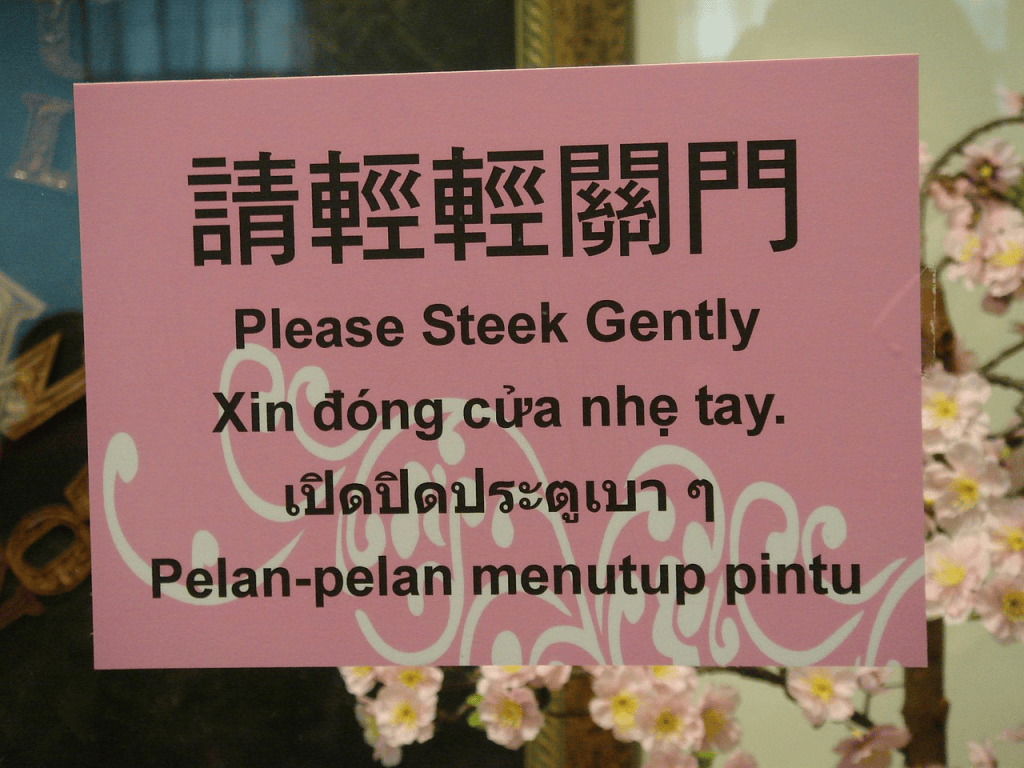
Additionally, the order of some parts of speech is different in Chinese compared to English. For example, the Chinese sequence in sentences usually follows the pattern of subject → adverbial → predicate → object, such as “我輕輕地關門” (literally “I gently close the door”), while in English, it is subject → predicate → object → adverbial, such as “I close the door gently”. Other differences may be in how topicalisations are expressed in English and Chinese, which would make some elements in a sentence appear in an unusual position in an erroneous English translation from Chinese.
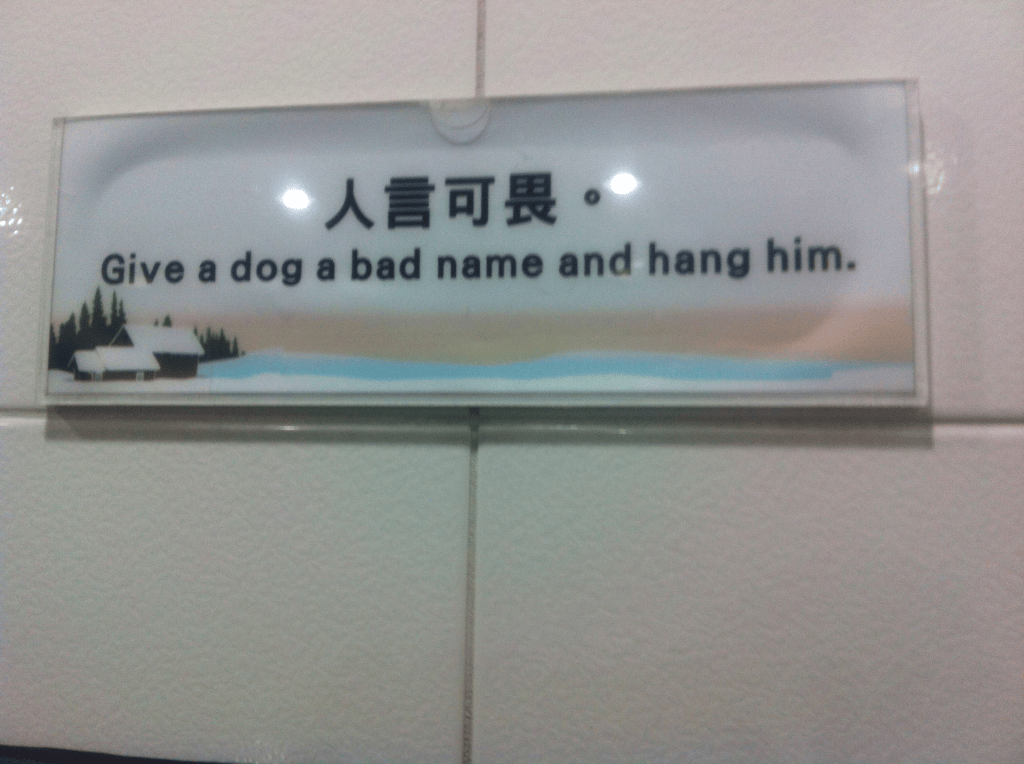
Another feature of Chinglish is how very often, Chinese idiomatic expressions get impressively lost in translation, like in the featured image to this very post. Many 4-character idioms, known as 成語, may employ grammatical and lexical features from Classical Chinese, making direct translations from these idiomatic expressions hilariously wrong, and losing the intended meaning of these expressions. For instance, 人言可畏, which was translated as “Give a dog a bad name and hang him”, actually carries the meaning of “gossip is terrifying” or “gossip is dreadful”. Perhaps a much closer meaning is the English saying “The tongue is not steel, yet it cuts.”, but somehow we yielded this erroneous translation in a sign somewhere in Kaohsiung.
However, despite these differences, why does this specific language pair have so many documented examples of poor-quality translations?

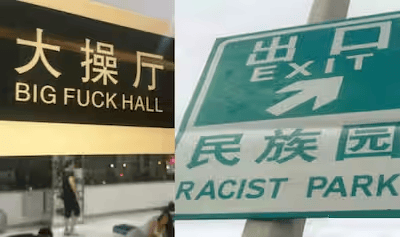
First and foremost, like Japan, China also scores fairly low in international standardised English tests, and generally lack the involvement of native English speakers or professional translators in the translation process. This effectively reduces the likelihood of quality control when these translations are made, increasing the chances of bad translations getting the pass. This is further compounded by the reliance on machine translation, which does not really effectively grasp the nuances reflected in Chinese, especially idiomatic expressions, and express them in English. Additional obstacles in the translation process include the use of direct word-for-word or character-for-word translation, and the use of outdated, non-standard, or inaccurate Chinese-English dictionaries. This would contribute to the erroneous translation of the phrase 加油 as ‘add oil’ instead of ‘good luck’. Furthermore, a single Chinese character could convey several meanings, such as 干 (traditional Chinese: 乾), which means ‘dry’ or ‘dried’, but can also mean ‘do’, and much more vulgarly, ‘fuck’. Without much of the quality control, proofreading, and editing process, poor quality translations of varying hilarity would thus become a phenomenon.

While many examples of erroneous translations are shown for the Japanese-English and Chinese-English pairs, there are also hilariously erroneous translations for the Korean-English language pair, likely attributed to similar reasons discussed for the aforementioned language pairs. I am not sure what the Korean parallel is called though. There is the Konglish term thrown about, but after looking into it, it appears that Konglish tends to cover words of English origin that have entered the Korean language, but have deviated from their original English meanings. Something like one shot (원샷) translating to ‘bottoms up’. This is better known as Korean-style English or 한국어식 영어 (hangugeo-sik yeongeo), which has a parallel with the Japanese 和製英語 (wasei eigo). Some have used Konglish to describe English-Korean mistranslations though, so I am unsure if this is an umbrella term for English words that have been appropriated into the Korean language used in South Korea.
Nevertheless, the presence of erroneous English translations or mistranslations does give a little insight into how the mapping of words and grammatical features from Chinese, Japanese, and Korean to English occurs in non-native English speakers, or how such translation is done by machine instead of more reputable or professional translators. These mistranslations have certainly achieved meme status in the anglosphere, though mistranslations do occur in any language pair worldwide, and not restricted to the major languages of Northeast Asia.

