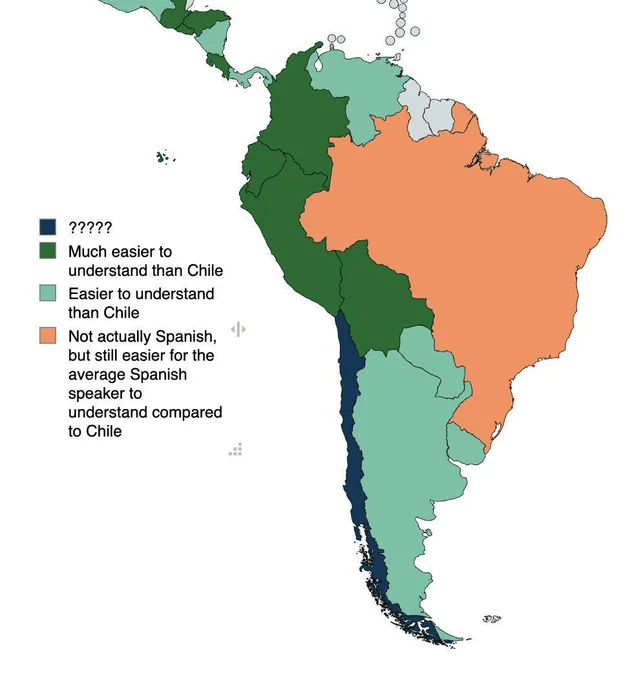
If you pull up maps of the comprehensibility of the various Spanish varieties, you might come across some examples of a certain long and thin country being highlighted and classified as ‘incomprehensible’. Initially, I thought it might be some banter amongst the Hispanosphere, since banter between language varieties and cultures is quite commonplace in online spaces. However, these presumed banter produced one consistent result, that Chileans use a variety of Spanish that sounds alien to Spanish speakers, with some saying that Brazilian Portuguese might be more comprehensible to some Spanish speakers than Chilean Spanish. And so today, I want to try to get an idea on what exactly makes Chilean Spanish so alien, or sound very divergent from the Spanish varieties most learners and speakers are more familiar with.
To clarify, we are looking at Chilean Spanish as it is spoken colloquially by the general middle class population. There are other subvarieties of Chilean Spanish which are influenced by other Spanish varieties or languages, such as the influence by Rapa Nui in the Chilean Spanish spoken in the island of Rapa Nui. Similarly, there is also Chilote Spanish spoken in the Chiloé Archipelago towards the south of Chile, which has received more influences from Mapudungun than other Chilean varieties. Some variation has been reported between social classes in Chile due to the degree of social inequality that exists in the country. As such, we would expect different sociolects of Chilean Spanish, as well as variations by geography.
Having pulled up recordings of Chilean Spanish being spoken in colloquial contexts, but predominantly from Santiago, my first impression was, that is somewhat fast. There were also some salient phonetic features that are consistent with other Spanish varieties in the South American continent, and others that definitely make this variety stand out. For instance, like other Spanish varieties in the Americas, Chilean Spanish uses seseo. That is, Chilean Spanish does not distinguish between /s/ and /θ/, instead realising these sounds as [s]. Additionally, Chilean Spanish, like Spanish varieties in Central America and Venezuela, uses yeísmo, which is the loss of the /ʎ/ sound, usually written ‘ll’, as in llamar (to call), with the /ʝ/ sound replacing it. As such, both the ‘ll’ and ‘y’ characters are usually realised as /ʝ/ in Chilean Spanish.
What I have also noticed was the omission of several sounds. While this characteristic alone is not particularly unique amongst Spanish varieties, it is the combination of these phonetic characteristics that make Chilean Spanish stand out as an anomalous Spanish variety. Examples of omitted, lenited, and elided sounds include the /d/ sound when it occurs between vowels and at the end of the word. That means for words like ciudad (city), this would be pronounced as [sjuˈða] in Chilean Spanish. Additionally, at the end of the word, the /s/ sound may either be omitted or be realised as [h], as with unstressed vowels that occur at the end of the word which tend to be devoiced. In more formal contexts however, this omission, lenition, or elision is less likely to occur.
There are differences in how the digraph ‘ch’ is pronounced in Chilean Spanish, and this depends on the social class. More affluent speakers in Santiago might pronounce this as [ts], while other speakers in the general population may pronounce it as [ʃ]. This affects even the pronunciation of Chile itself, which can range from [ˈʃile] to [ˈtsile] depending on the place and person. Lastly, velar consonants like /k/, /g/, and /x/ may be palatalized to /c/, /ɟ/, and /ç/ respectively when they occur before the vowels /i/ and /e/.
Other phonetic differences may be attributed to influences from Mapudungun, which we should introduce here. Mapudungun is an indigenous language predominantly spoken in central-south Chile, which is often classified as a language isolate. Mapudungun has the retroflex consonant /ɻ/, which may be heard in the consonant cluster ‘tr’ in Chilean Spanish. Here, it may be realised as [tɻ], [tɹ̝̥], or even [tʂ], the lattermost of which is a Mapudungun sound as well. Additionally, while spoken Chilean Spanish may sound fast and melodic, there are stretches in Chilean Spanish speech that have intonational plateaus in which the pitch is level.
Where Chilean Spanish is most likely to stand out as well is the vocabulary and slang, collectively referred to as chilenismos. A substantial proportion of Chilean Spanish words deviate from words in other Spanish varieties, including the Spanish spoken in Mexico. Part of this is attributed to the linguistic influences this language variety has received from other languages and macrolanguages like Mapudungun and Quechua. For example, many Spanish speakers might be familiar with the chancla (flip-flop, or a thong if you are an Australian). In Chilean Spanish, however, you might come across the word chala, an influence from Quechua. Some of the more salient examples of chilenismos include weón (dude, or stupid), wea (thing), fome (boring), cachar (to understand, as in ¿Cachai?, Do you understand?), bakán (especially in Central Chile, cool, awesome), filete (cool, awesome, but more intense than bakán), and al tiro (like Spanish ahora, right now). Another chilenismo is the word poh, which is used to emphasise a certain topic or idea, derived from the word pues after some sound changes.
I also find it interesting that the word taco takes on further meanings than the culinary item found in Mexican cuisine. In Chilean Spanish, taco takes on the additional meanings of road traffic, like traffic jams, and is also used to refer to the heel on women’s shoes. Rhyming with taco is the chilenismo called paco. It is used to refer to the police, which in Chile, is called the Carabineros, as an English speaker would use the word cop, popo, or bobby (somewhat archaically). While paco is preferred to the Spanish word policía, it is rude to directly call a Carabinero a paco due to the respect for the profession.
Chilean Spanish has also received influences from Argentine Spanish, although the converse is not as extensive. Examples of these words include yeta (jinx), trucho (fake, cheat), and canchero (arrogant). Chilenismos deriving from Mapudungun predominantly encompass words for plants, animals, and place names, which include cuncuna (caterpillar), pololo (the Astylus trifasciatus beetle, also boyfriend), and colo colo (pampas cat). However, there are also some quantity words such as pichintún (a pinch) and pichiruchi (tiny, insignificant). Chilean Spanish words for some vegetables also tend to derive from Quechua, in contrast to other Spanish varieties which may derive these words from Nahuatl and Taíno. This includes palta (avocado), poroto (bean), choclo (maize, corn), and callampa (mushroom, but also penis). Other loanwords derive from European languages such as French, German, and English, attributed to immigration in the 19th and 20th centuries, with further influences originating from popular culture in media, and more recently, the Internet.
There are also some grammatical differences between Chilean Spanish and other Spanish varieties, such as the lack of the word nuestro/nuestra (our), instead preferring to use the expression de nosotros. In addition to some conjugation differences between Chilean Spanish and other Spanish varieties for verbs such as ser, haber, and ir, I would say that the grammatical differences are not particularly as stark especially in comparison to the chilenismos and phonetic differences.
While there are some features and words that may overlap with other Spanish varieties, the combination of these features and influences from other languages come together to contribute towards what some linguists think is the relatively divergent nature of Chilean Spanish. When complemented with the relatively fast nature of spoken Chilean Spanish, I can understand how this has given the Spanish variety the accolade of being ‘incomprehensible’ to even native Spanish speakers.

