
As we have mentioned several times on this website before, the Austronesian people groups are known for their seafaring traditions, which allowed them to expand from present-day Taiwan into the vast seas and oceans, bringing their languages and cultures with them to these far-flung islands. Many of these languages are associated with islands and archipelagos in the South China Sea and the Pacific Ocean, stretching from Sumatra in Indonesia all the way to Rapa Nui or Easter Island to the east. However, there has been a westward expansion of Austronesian languages and cultures, in an island country called Madagascar today.
Madagascar perhaps needs no introduction. An island in which lemurs are endemic, it is generally agreed upon that Madagascar had no human settlement until the 5th century, when Austronesian cultures from the southern regions of the island of Borneo would migrate and settle in Madagascar. This was then followed by the arrivals of Arab traders, and later on, Bantu migration, and European colonisation. Nevertheless, the Malagasy language remains predominantly spoken by the citizens and residents of Madagascar, making up more than 25 million native speakers across Madagascar, Comoros, and the Malagasy diaspora. Malagasy is classified as an Austronesian language, under the Malayo-Polynesian branch, as part of the East Barito group of languages. This makes Malagasy closely related to languages such as Ma’anyan and Lawangan, which are spoken in Central and South Kalimantan in Indonesia.
We have actually talked about the Malagasy language before, and the diversity of Malagasy varieties within Madagascar alone. But to summarise, Malagasy has been described as a dialect continuum, with numerous varieties spoken throughout Madagascar. Some varieties are more mutually intelligible with one another than others, leading to the proposed classification that Malagasy is, in fact, a macrolanguage, with 12 Malagasy varieties being allocated their own ISO 639 codes, and Ethnologue, a major language catalogue, recognising at least 12 distinct Malagasy languages, from Sakalava Malagasy to Antankarana Malagasy.
Generally speaking, Malagasy could be split into two major variety groups, which are the Eastern and Western groups. Eastern Malagasy varieties such as Merina Malagasy and Antambahoaka Malagasy tend to be spoken in the highland regions of Madagascar, while other varieties of Malagasy such as Sakalava Malagasy and Tsimihety Malagasy tend to be spoken towards the coast and lower altitudes. These varieties not only differ in phonologies, but also in vocabulary. For example, ‘white’ would translate to malandy in the north, fotsy in the center and east, and foty in the south. Merina Malagasy, a plateau variety of Malagasy, forms the basis of Standard Malagasy, the standard language used in education, media, and official proceedings. As such, this introduction will primarily focus on the standard variety, though within the Merina Malagasy-speaking regions, differences do exist between regions and with Standard Malagasy.
When one talks about the capital of Madagascar, Antananarivo, you might hear a slight clipping in the very last syllable. This is because of a reduction of the vowels /a u i/ to [ə, ʷ, ʲ] in syllables after stressed syllables, which usually targets the end of words (or together with the penultimate syllable). Additionally, devoicing of final syllables (and final /a/) may sometimes occur. See, stress usually occurs in the penultimate syllable, except for words ending with –ka, –tra, and –na, in which case the stress would land on the third-last syllable. Additionally, there are secondary stresses which occur on words longer than four syllables, landing on even syllables when counting from the last stressed syllable.
Interestingly, some Central Malagasy varieties have been reported to be undergoing some form of tonogenesis, wherein the low tone derives from voiced consonants, while a high tone derives from voiceless consonants. This pattern of tone development is rather restricted though, as stress and intonation can modulate how these tones are realised. Some might describe it as a ‘pitch-accent’, but it is perhaps better described as a restricted tone system.
Malagasy affricate and plosive consonants are distinguished by voicing, and also carry pre-nasalized forms, where a nasal consonant and an obstruent consonant occur in a sequence. While pre-nasalized consonants do occur in the Oceanic branch of the Austronesian language family, when comparing Malagasy with its other Barito language cousins, we find that Barito languages mostly lack pre-nasalized consonants. This could suggest that pre-nasalization could be either a retention of an ancestral feature, or a product of linguistic influences brought on by the Bantu migrations to Madagascar. There are also retroflex consonants in Malagasy, though I am unsure how these could have arisen.
Perhaps the most salient feature of Malagasy is its unusual verb-object-subject canonical word order, but there are different possible alignments that places emphasis on certain elements in a sentence. This is attributed to the focus system of Malagasy, something that can be found in other Austronesian languages, though how this occurs differ from language to language. In any case, the focus in many basic sentences lies on the agent. In passive voice, this focus lies on the patient, and there is this focus on instrumentality (by what means did you do something?). This focus system is expressed by the variations in the verb forms, which are also additionally conjugated for tense. For example, Manasa ny tanako amin’ny savony aho would translate to “I wash my hands with soap”, with an emphasis on the agent, “I”. The passive voice would be Sasako amin’ny savony ny tanako, or “My hands were washed with soap by me”, and the instrumentality focus would translate to Anasako ny tanako ny savony, “It is with soap that my hands were washed by me”. If we compare the word orders, they are still consistently VOS when we analyse them by the corresponding focus.
Malagasy, being related to some degree to Bahasa Melayu, does indeed share many similarities in their words. This even includes words borrowed from Sanskrit, finding their way into Malagasy through influences from Bahasa Melayu and Javanese as well. Over time, Malagasy speakers would interact with the Bantu languages, borrowing some words from languages like Swahili, such as kibory (from kabouri, ‘grave’). Malagasy would also have some loanwords from Arabic as well, such as jigny (from jinn, a type of ghost in Arabian folklore).
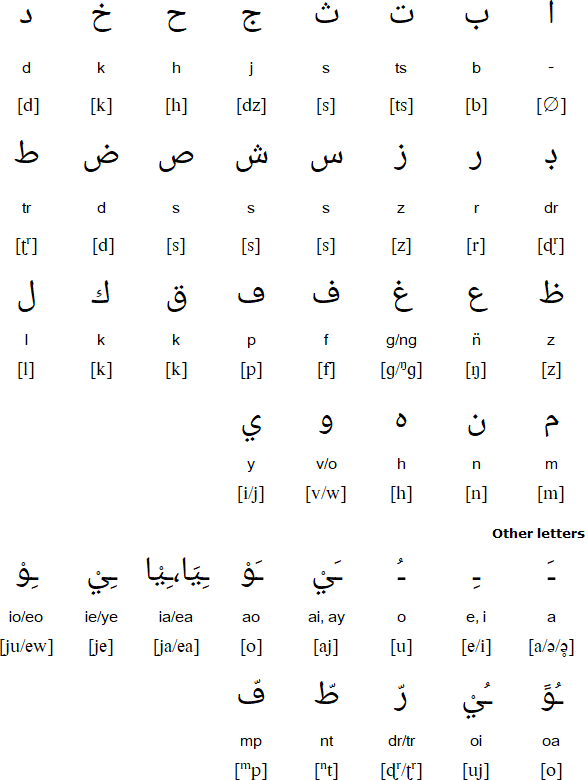
Arab influences have also extended to the writing system that Malagasy once used, called the Sorabe script. Estimated to have dated back to the 15th century, this script is based off the Arabic script, with some Malagasy literature developing since. There are some interesting innovations to try to write the retroflex and pre-nasalized consonants, and perhaps some of the diphthongs that Malagasy has. One example is the use of the shaddah above letters like ر (making رّ) to write the sounds /ɖʳ, ᶯɖʳ, ʈʳ, ᶯʈʳ/. These sounds would be written as dr, ndr, tr, and ntr today. As you can see, Malagasy is written using the Latin alphabet today, with grave accents denoting stressed syllables.
Should you want to learn Malagasy, resources are relatively less easy to come by in comparison to other languages with similar sizes of speaking populations. Nevertheless, there are extensive online dictionaries of Malagasy such as the Malagasy Encyclopedic Dictionary, which contains entries for 109 000 Malagasy words and expressions and several thousand more proverbs. There are also some online Malagasy courses on Live Lingua, which are based on the courses developed by the Peace Corps, so check them out should you be interested.

