Three years ago, I had the opportunity to visit Vienna, the largest city on the Danube (or Donau), and the second-largest German-speaking city only behind Berlin. Situated in the region where the Bavarian dialects are found, I would expect to come across certain words, terms, or expressions that would deviate from what I am familiar with in German. But like pretty much the German-speaking sphere, Vienna has a certain dialect that makes it stand out amongst the Central Bavarian dialects. This is Wienerisch, or in Bavarian, Weanarisch. Viennese German is a specific variety of Bavarian spoken predominantly in Vienna, which formerly had at least four different sub-varieties spoken in the city’s districts. However, this distinction is long gone today.
My visit to Vienna was not the only source of inspiration for today’s introduction. Tapakapa is perhaps among the most recognisable YouTube channels that speak Viennese German, through his second channel Tapakapa Erklärt. While I do not exactly understand a bunch of the colloquialisms and differences between Viennese German and the German I am more familiar with, there are several patterns I have picked up every now and then that are worthy of note.
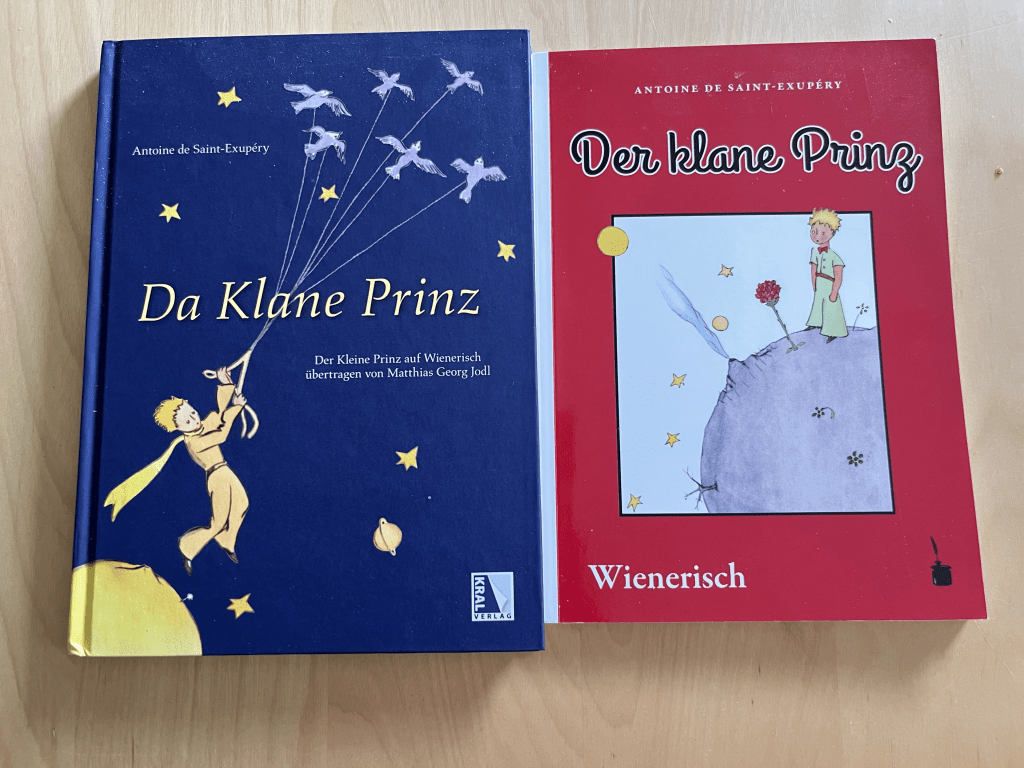
To add more to today’s introduction to Viennese German, I managed to get my hands on two translations of The Little Prince, one done by Matthias Georg Jodl (titled Da Klane Prinz), and the other done by Hans Werner Sokop (titled Der klane Prinz). Entering the translations I will be comparing against, these are the Standard High German translation and the Bavarian translation (by Gerd Holzheimer, titled Da Kloa Prinz). I tracked these translations from the collector website linked here.
I would like to start by mentioning certain key features highlighted by the collector website. Firstly, the translation by Jodl features characters speaking using different varieties of German. While the little prince speaks in Standard High German, as with the King in Chapter 10, the other characters predominantly speak in Viennese German or its related varieties. It probably underscores some differences in tone between characters associated with nobility, projecting a variant of German that is different from the variety most other characters used in the book. The fallen pilot, the geographer, and even the fox, they all spoke in Viennese German or related dialects.
The translation by Sokop however, was remarked as less appropriate, as it included more slang terms found in colloquial Viennese German, and did not, at least to the collector, quite suit the nuances and contexts present in the book. Seeing that the collector site has an Austrian top-level domain, and that the collector speaks German, this remark has some convincing weight to it. Now it is a matter for me to identify these words or expressions.
The first difference is the prominence of diphthongs in Standard High German or Bavarian articulated as monophthongs in Viennese German. This phenomenon is known as monophthongisation. In a way, this reminds me of that clip showing the pronunciation of “oil” as “o-ol” in Southern US accents. Other differences also include this phenomenon called ‘epenthesis’, where a vowel sound may be inserted into consonant sequences, making an additional syllable in the word. The socio-linguistic implication of this phenomenon in Viennese German is the conveying of an intensified expression in a manner that carries a negative connotation.
One of the more distinguishing features of Viennese German is how the /l/ sound differs from what we are more or less familiar with in Standard German or some German dialects. In Viennese German, we might have come across the term ‘Meidlinger L’. This points towards the Meidling district in southwestern Vienna, where historically, was an area where many working class residents lived. However, there are also other districts that also feature the ‘Meidlinger L’ that are not in Meidling, such as the neighbouring district of Favoriten. This is despite there formerly being Viennese German sub-varieties such as Favoritnerisch and Meidlingerisch. Reading up on its history, it seems that this development of the ‘Meidlinger L’ points towards a process occurring in a certain social-class, rather than an areal thing.
The ‘Meidlinger L’ is the ‘darkening’ of the /l/ sound, much like the ‘l’ sound as it is pronounced in words like ‘full’. Such a phenomenon is present in English, but it primarily occurs at the end of a syllable, with the syllable-initial /l/ sound being called the ‘clear L’. In both cases, these dark and Meidlinger L sounds would involve the velarisation of the /l/ sound, particularly the raise tongue body towards the velum.
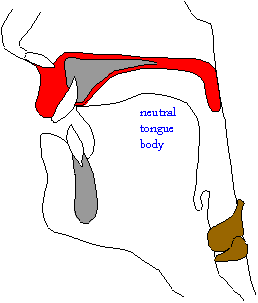
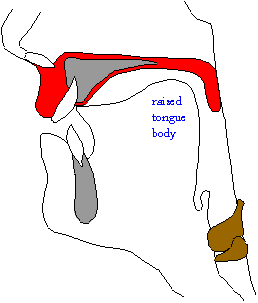
Origins of the Meidlinger L point towards Czech immigrants settling in Vienna, but in the Favoriten district rather than the Meidling district. Czech phonology does indeed feature the dark L sound, where the /l/ sound may be articulated with velarisation. But this origin is under dispute, as according to the linguist Eberhard Kranzmayer, the Czech L is more similar to the Standard German L, while the Viennese German L is more ‘post-dental in certain social classes’.
Another likely theory is how ‘l’ sounds are different in Viennese German. Here, There is a rather extensive vocalisations of the /l/ sound, that is, the realisation of the /l/ sounds as vowels or semi-vowels. This also occurs at the end of words like Standard German’s schnell, ‘fast’, which becomes schnöö in Viennese German. This may also happen in the middle of a word, often after a vowel, making German words like also, ‘so’, being pronounced as oeso in Viennese German. While these patterns are also found in other Bavarian dialects, it is perhaps the additional velarisation in these sounds that could have given rise to the impression of the dark L or the Meidlinger L sound.
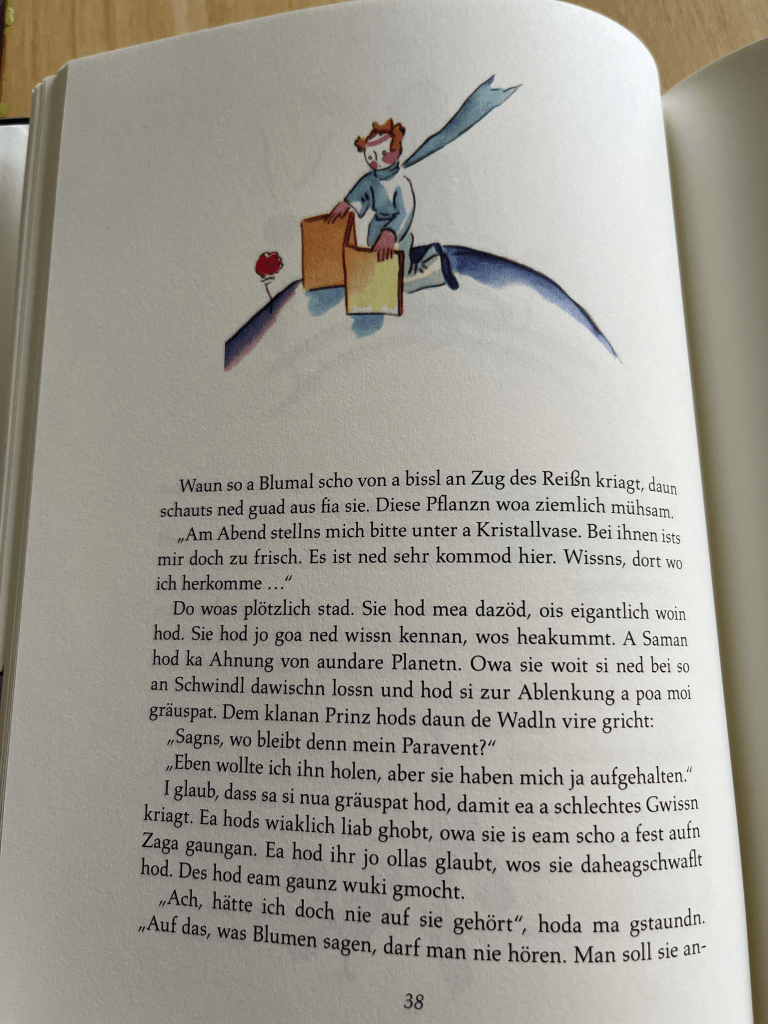
Reading through Da Klane Prinz and Der Klane Prinz books, it seems to be the case that like many German dialects, there is no set orthography for Viennese German, and so there are multiple approaches one could take to write the dialect. Additionally, it does not seem that Viennese German grammar deviates much from Bavarian grammar, especially when I compared these two translations with the Bavarian one.
But like some dialects, there appears to be an aversion towards the genitive case, and some words like ohne (without) take the accusative case instead of the dative case. Some grammatical differences apply more towards Austrian German in general though, such as the pronoun that the verb sich schwertun (to have difficulty) takes. Some rare cases in which the genitive case is used include expressions such as Um Gotts Wülln (compare with German Um Gottes Willen, For God’s sake). Perhaps one notable pattern is the formation of the diminutive in Viennese German, which uses the suffix -erl in contrast with Standard High German’s -chen.
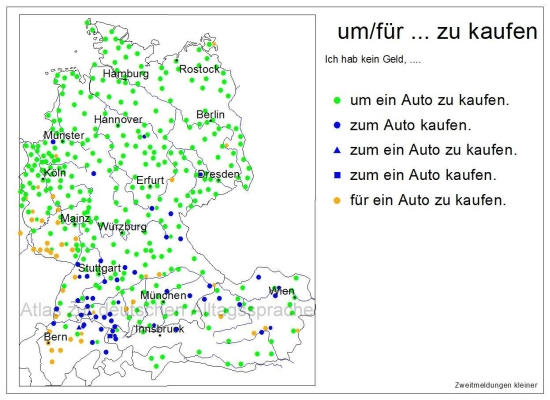
One of my favourite websites I like to visit to learn about variations in the German dialects is the Atlas zur deutschen Alltagssprache or the Atlas of Everyday German Speech. It features a lot of regional variations in the language in various aspects, such as terms for ‘house shoes’, and even expressing a certain time (10:15). It has served as a resource for introductions covering German dialects spoken in Germany, Austria, and Switzerland, with visualisations of where a certain expression, word, or grammatical variation can be found:
But where Wienerisch predominantly differs from many other Bavarian and German dialects is its vocabulary. This does not just stop at the different names the Viennese give to their food. It turns out that Viennese German has actually retained words or expressions from Middle or even Old High German roots, and also incorporating words originating in other languages in the region. This includes words like Tschick, from the Italian cicca (compare with Standard High German Zigarette, cigarette), and Trottoa, from the French trottoir (compare with Standard High German Gehweg, pavement).
The pattern of forming diminutives is a pretty interesting one in Viennese German and the Bavarian dialects. While one would assume that the diminutive would imply a smaller, or a more familial version of the noun that is modified, this might not always be the case. More rather, it works a little like Australian English’s diminutives — to express some form of sympathy. However, some of these apparent diminutive forms do not have a so-called large, or less sympathetic variant, such as Stamperl (shot glass). There is also the -l suffix, which is used to differentiate between certain sympathetic variants of a certain word. A popular example are the words Glos (glass), Glosl (drinking glass), and Gloserl (glass but familiar).
Perhaps one word you might come across is the word Leiwand. It seems to be uniquely Viennese German or at least Austrian German, which translates to ‘good’ or ‘super’, and it is an antonym of the Austrian German word Schas (bad, stinker, etc.), which is related to the German word that translates to ‘shit’, Scheiß. Similes or figurative speech are also quite common, with one of the most relatable ones being schiach wia da Zins (hässlich wie die Mietzahlung, ugly as rent payment).
As previously mentioned, the Viennese German dialect is pretty much alive and well, with publications, videos, and other forms of digital media in the dialect being widely available for everyone to consult and appreciate. However, like pretty much every single language and variant, Viennese German is undergoing some forms of change, just as it, well, more precisely, its sub-variants did in the past. What I did notice during my trip was that the dialect could eventually become essentially just Austrian German with a Viennese accent, or with additional words from other languages entering Viennese German use, just like how it occurred during Vienna’s history. Vienna still is a hub of activities and ideas, attracting immigrants to the city. This could further influence how Viennese German sounds, and which words enter the dialect.
Further Reading
Dressler, W. U. & Wodak, R. (1982) ‘Sociophonological methods in the study of sociolinguistic variation in Viennese German’, Language in Society, 11(3), pp. 339-370.
Kranzmayer, E. (1956) Historische Lautgeographie des gesamtbairischen Dialektraumes, Vienna.
Sedlaczek, R. (2011) Wörterbuch des Wienerischen, Haymon Taschenbuchverlag.
Wehle, P. (2012) Sprechen Sie Wienerisch?, Ueberreuter, Vienna.
Vollmann, R. & Moosmüller, S. (1999) ‘The change of diphthongs in Standard Viennese German. The diphthong /æ/, International Congress of Phonetic Sciences, pp.345-348.
Comparison between some German and Viennese German expressions:
http://www.reisemobilstellplatz-wien.at/deutsch/wien/Lexikon/lexikon.htm

