A long while ago, we left off the Languages of Taiwan series covering topics in Taiwanese Hokkien, from my experiences learning it, to the different ways that have been proposed to write it. Today’s focus takes us to another language spoken in Taiwan, one that is spoken by at least a million speakers today. Recognised as a national language in Taiwan alongside Mandarin, Hokkien, the indigenous languages collectively known as the Formosan languages, Matsu, and Putian, this is Taiwanese Hakka.
But before we talk about Taiwanese Hakka, we have to talk about what Hakka is. Hakka forms a language group of Chinese varieties predominantly originating in some parts of Southern China, and is collectively spoken by more than 40 million people today. Hakka is also spoken by a wide diaspora, with speakers in Taiwan, Southeast Asia, and even beyond. This geographical spread has also resulted in numerous varieties of Hakka, with varieties spoken in Taiwan differing from those spoken in Mainland China. Nevertheless, there have been attempts at standardising Hakka in Mainland China, with the Moiyen variety being treated as the ‘standard’.
Hakka has been hypothesised to branch off from Old Chinese at some point before the 5th century, during periods of Hakka migration from northern to southern China, caused by war and civil unrest. As such, Hakka has preserved some features seen in Old Chinese, but do not exist anymore in Modern Mandarin Chinese. As migration occurred, the Hakka people would also have interacted with other languages, receiving influences from languages such as Min and She. Over time, as the Hakka diaspora grew, Hakka would develop more varieties, influenced by languages spoken in the geographical vicinity.
Within Taiwan, Hakka is spoken by at least a million people, representing about a quarter of the Taiwanese who identify as Hakka (around 4 million), and about 4 – 5% of the total population of Taiwan. While Hakka has attained national language status in Taiwan, there is a decreasing trend in the number of speakers of the Hakka varieties, especially amongst youth. Having a dialectal variety within Taiwan, Taiwanese Hakka has no standardised form, presenting a challenge in how Hakka may be taught in schools. As such, even though Hakka is seen in public broadcasts and mass media, its predominant use is still restrained within the family or within local speaking communities. To deal with this decline, the Hakka Affairs Council was established in 2012, which aims to revitalise the Hakka language and culture, as well as promoting cultural research.
As aforementioned, Taiwanese Hakka consists of multiple varieties, and a handy mnemonic to highlight the most major varieties in Taiwan would be 四海永樂大平安 (Sì Hǎi Yǒng Lè Dà Píng Ān), which roughly translates to ‘eternal happiness and peace throughout the world’. The translation is janky, but that is what one would expect of a rough translation. This is named so after the seven main dialects of Taiwanese Hakka, Sixian (四縣), Hailu (海陸), Yongding (永定), Changle (長樂), Dabu (大埔), Raoping (饒平), and Zhao’an (詔安). The most common spoken two varieties are the Sixian and the Hailu varieties, with Sixian Hakka being the most widely spoken Hakka variety, having consistent appearances in mass media and public broadcasts. Nevertheless, phonological and lexical differences are present between each variety, with some varieties having more phonological tones than others, or perhaps having a certain set of consonants that other varieties lack. With this in mind, we can go deeper into some of the features of Sixian Hakka.
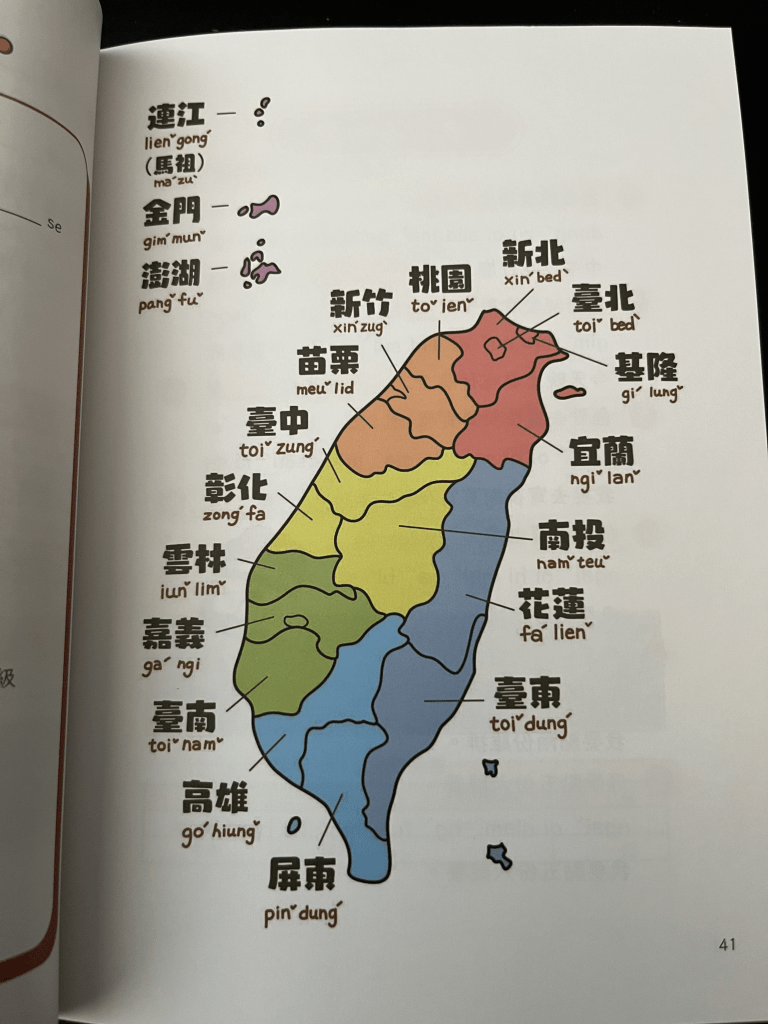
Sixian Hakka is generally spoken in northern and southern Taiwan, though the latter is considered a subvariety called Southern Sixian Hakka, or 南四縣. As such, Sixian Hakka is spoken in northern Taiwanese counties such as Taoyuan and Miaoli, and Southern Sixian Hakka is spoken in southern Taiwanese counties such as Kaohsiung and Pingtung. This has also resulted in some vocabulary differences between the northern and southern Sixian Hakka varieties. Comparing Sixian Hakka to the varieties spoken in mainland China, and considering the history of migration of Hakkas from mainland China to Taiwan, it appears that Sixian Hakka would be most similar to the Hakka spoken in modern-day Jiaoling County in mainland China.
| Sixian Hakka | Southern Sixian Hakka | Mandarin Chinese | English |
| 當 (dongˊ) | 蓋 (goi) | 很 | very |
| 笑 (seu) | 核 (hedˋ) | 笑 | laugh |
| 轉 (zonˋ) | 歸 (guiˊ) | 回 | return |
| 恁仔細 (anˋ ziiˋ se) | 多謝 (doˊ qia) | 謝謝 | thank you |
| 逐 (dagˋ) | 每 (miˊ) | 每 | every |
| 還吂 (hanˇ mangˇ) | 還毋曾 (vanˇ mˇ qienˇ) | 還沒 | not yet |
Sixian Hakka has 4 or 6 tones, depending on how checked tones are treated, that is, if tones on syllables that end with stop consonants (think /k t p/) would count as distinct tones. These tones are the rising or mid-level tone (depending on where Sixian Hakka is spoken), low-level tone, falling tone, and the high-level tone. For checked syllables, the two tones are the low and high tones.
Being a predominantly spoken tongue, I have been interested in how the Hakka dialects are transcribed. After all, with the considerable number of Hakka varieties, creating a standardised script would be an extremely tall order. Nevertheless, Chinese characters (hon sii in Hakka) are still used to write Hakka, with some notable differences that reflect the differences between Hakka and Mandarin Chinese. For example, the word ’embarrassed’ translates to 害羞 (hài xiū) in Mandarin Chinese and 見笑 (gien seu) in Sixian Hakka, and ‘kitchen’ translates to 厨房 (chú fáng) in Mandarin Chinese and 灶下 (zo haˊ) in Sixian Hakka. Combined with some grammatical differences, these sentences can appear quite different. For example, compare the two sentences below, the top being Mandarin Chinese, and the bottom being Sixian Hakka, both translating to ‘What do you want to eat for lunch?’:
- 中午要吃什麽?
- 當書愛食麽个?(dongˊ zu oi siid maˋ ge?)
As such, when learning written Hakka, I feel like I am for some part relearning how Chinese characters are read, as with my experience learning written Hokkien. Like Hokkien’s pe̍h-ōe-jī, however, Hakka does indeed have its own Latin transcription, called pha̍k-fa-sṳ, which tries to transcribe some varieties of Hakka. Tone marks here may be present in some Hakka varieties, while absent in others. For instance, Taiwanese Hakka varieties generally do not distinguish the 陰上 (yīn shǎng) and 陽上 (yáng shǎng) tones, and Sixian Hakka does not distinguish the 陰去 (yīn qù) and 陽去 (yáng qù) tones.
There are more Latin transcription methods for different varieties of Hakka, such as the Taiwanese Language Phonetic Alphabet for Taiwanese varieties, Hagfa Pinyim, developed by the Hong Kong-born linguist Lau Chun-fat for his 1997 Hakka Pinyin Dictionary, and Pinfa, developed by the Guangdong Provincial Education Department in 1960. The Hakka transcriptions I have used in the examples though are based off a coursebook I have been using to learn about the Sixian variety, shown below, and mentioned later.
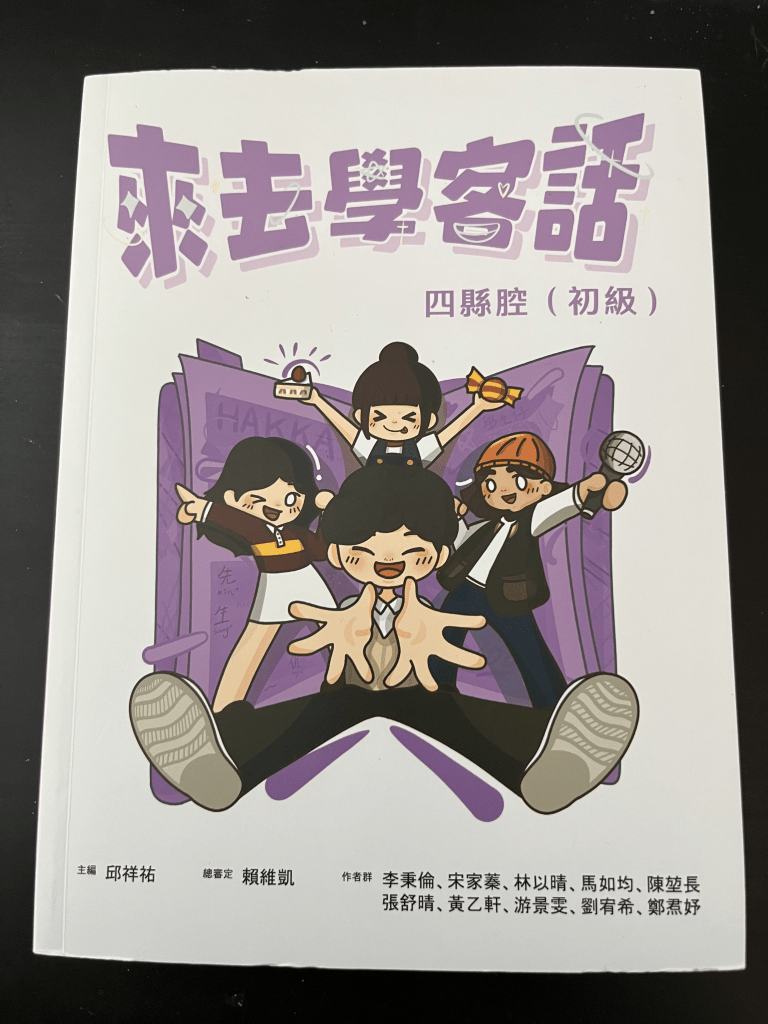
Besides some family members and Hakka and Chinese cultural centres, the Hakka dialect resources I have consulted includes a Taiwanese textbook, translated as ‘Let’s learn Hakka’, or 來去學客話, a textbook targeted at beginners of Hakka. With its own pinyin guide (with bopomofo equivalents) complemented with traditional Chinese characters, and online audio recordings, this coursebook gives a little insight on how Taiwanese Hakka may be transliterated using Chinese characters, and how to match character to sound. I would want to do a little reflection on my time learning Taiwanese Hakka, or perhaps give the book a little review.

