Southeast Asia is perhaps one of the most culinarily diverse regions in the world, with many dishes gaining widespread fame (and sometimes notoriety), and reflecting the cultural exchanges that have influenced the culinary scene here. After all, nestled around one of the most trafficked maritime trade routes, Southeast Asia would have facilitated not only the trading of spices and goods, but also served as a melting pot where different cultures with different culinary traditions would mix and influence one another.
This gives us the region that has anything from ayam penyet (literally ‘flattened chicken’, from Bahasa Indonesia) to kaeng khiao wan (literally ‘sweet green curry’, from Thai), from samlor prahal (literally ‘fragrant soup’, from Khmer), to bánh tráng trộn (literally ‘rice paper salad’, from Vietnamese). Some of these dishes have been created using influences from China, India, other regions in Southeast Asia, or Europe, with one of the most popular ones being the Vietnamese baguette sandwich bánh mì (literally ‘bread’). And so today, I want to dedicate today’s introduction to one of my most favourite dishes from the region.
This dish has been largely agreed upon to be of Peranakan Chinese origin, who are the descendants of the first waves of Southern Chinese migration to maritime Southeast Asia, which included trading port cities such as Malacca and Singapore. However, where exactly this dish comes from is unclear. This dish is known as laksa.
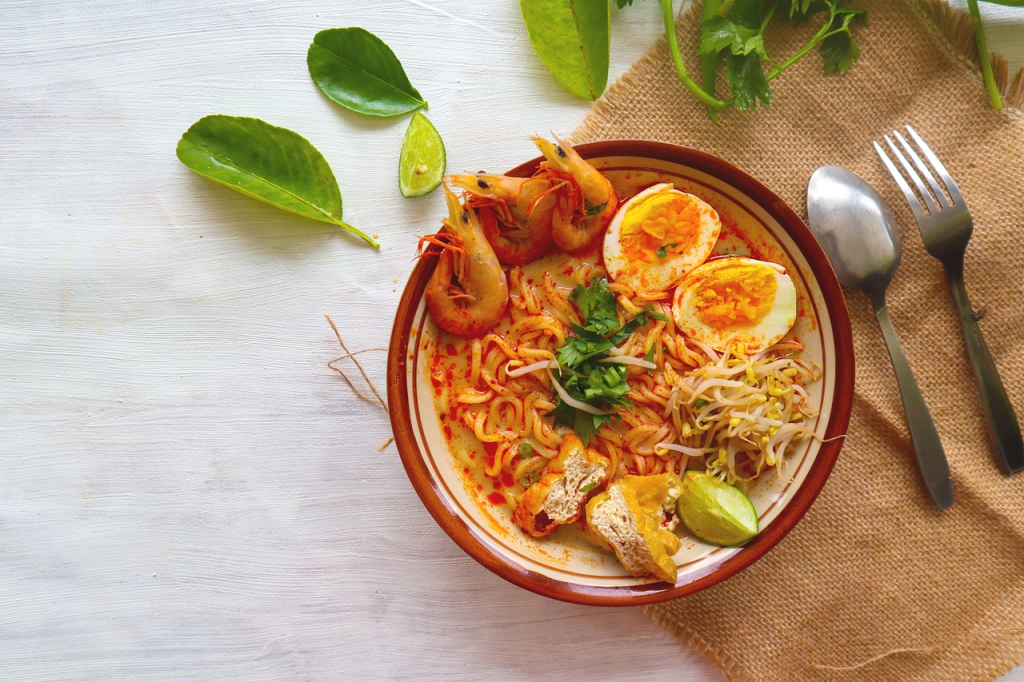
The most common image conjured when we think of laksa is the one created using coconut milk as a soup base and a prawn stock. Occasionally, a chicken stock may be used instead of a prawn stock. This could be why in Singaporean food courts, I would usually find laksa sold in the same stalls as prawn noodles. However, other variations exist, such as Penang asam laksa which uses a fish-based broth such as mackerel, with more sour ingredients such as tamarind and pineapple incorporated as well. In contrast to the thick, fatty, and savoury profile of laksa in say, Singapore, Penang asam laksa has a more sour, but also a more fragrant profile from herbs like mint.
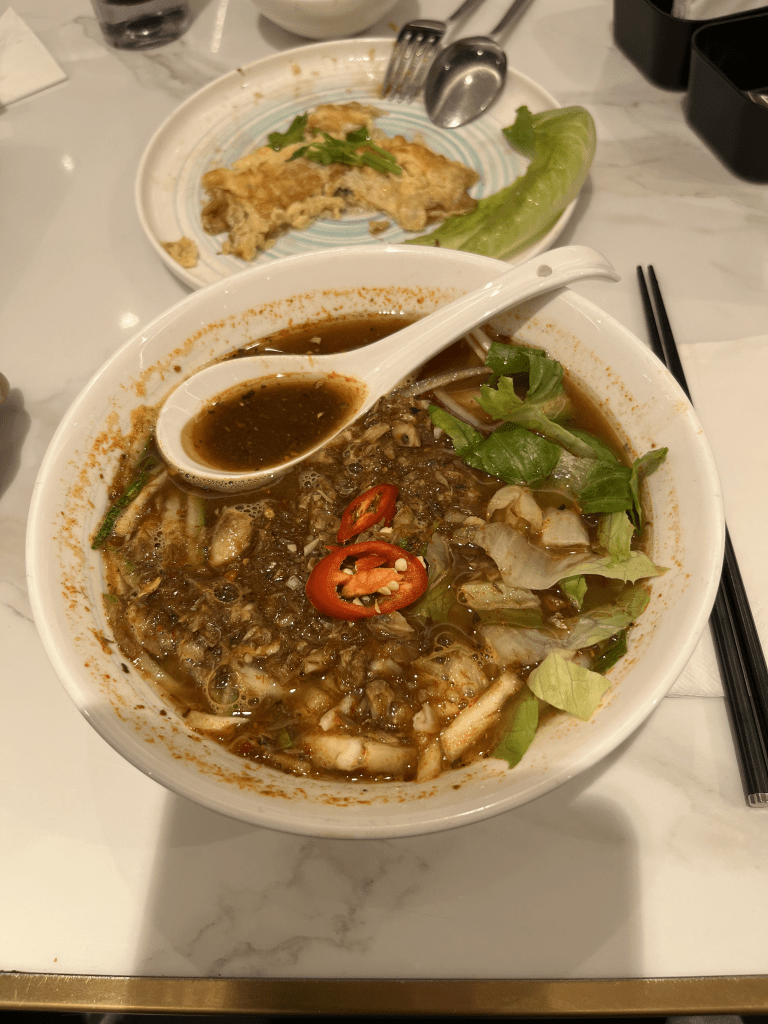
Given the unclear geographical origins of laksa, alongside the variations of the dish, coming up with a proper definition of the dish is difficult. The unifying characteristics of laksa may be as such:
- It is a spicy noodle dish served in soup
- This dish may be topped with prawns or other kinds of meat such as chicken or fish
- The soup or broth is usually a coconut milk-based spicy soup or a fish-based soup prepared with a sour ingredient like tamarind. Many soups may contain shrimp paste as an ingredient.
But unlike dishes such as rojak (literally ‘mix’, from Bahasa Melayu) and yong tau foo (literally ‘stuffed tofu’, from Hakka), which names give a basic description of the dish or the main cooking method used, laksa, from the surface, does not seem to give such an indication. With the number of geographical variations laksa is available in, I am interested in understanding more about what lies beneath the name of the dish itself.
Given its origin as a Peranakan Chinese dish, I thought it would be logical to look into the Chinese languages as possible origins for the dish’s name. Today, it is usually written as 叻沙 (Mandarin Chinese lè shā), a phonetic transcription of the word laksa itself. So, that is not really that informative on its own. However, an alternative albeit more uncommon writing is 辣沙, where the 辣 character means ‘spicy’, and 沙 could refer to the granular texture or appearance of the soup, likely due to the coconut milk curdling under this cooking method, or from the use of dried or ground prawns in the making of the dish.
Further support for this proposed etymology may also come from the pronunciation of 辣沙, which is thought to be from one of the varieties of Min Chinese, such as Hokkien or Teochew. As Peranakan Chinese can mostly trace their roots to Southern China, we would expect that they would also be speakers of varieties of Min Chinese, or varieties of other Chinese languages spoken in Southern China. In cities such as Malacca, the interactions between Peranakan Chinese and Malays would have introduced the word 辣沙 to the language, and could be rendered as laksa in the Malay varieties.
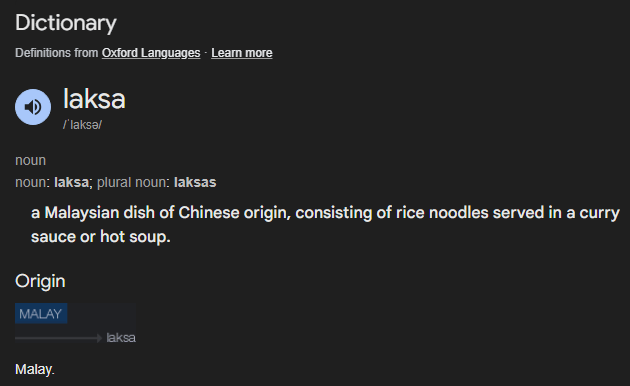
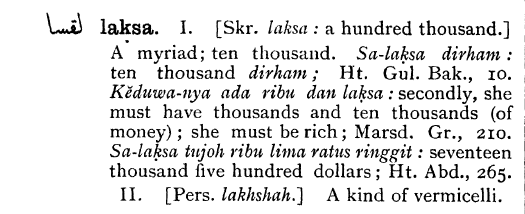
Many online sources, including the National Library Board of Singapore, also suggested that the word laksa might actually have a Persian or Sanskrit origin. The proposed words of origin include the Sanskrit laksa which means ‘a hundred thousand’, and the Persian word lakhshah which refers to some sort of vermicelli, a type of noodle that may be used in laksa itself. As such, an alternative hypothesis goes that the word laksa would have just referred to the noodles themselves.
Persian influences in the languages of Southeast Asia are not necessarily an unusual occurrence. For instance, the word shah is used in Malay to refer to a ruler, and finds its roots in Persian. The Malay word for ‘grape’, anggur, also finds its origins in Persian angur. After all, historical trade by Persians through Southeast Asia, like trades from India, China, Europe, and beyond, would have also brought upon influences in the languages used by traders, and spread amongst speakers of the respective languages.
Given such trade routes used by the Persians, we should expect to see some languages spoken in areas overlapping with these important trade routes to use laksa, or some derivative form of lakhshah, to refer to noodles or noodle dishes. This is where we would encounter words along the lines of лапша (lapsha), typically used in Slavic languages such as Russian and Crimean Tatar to mean ‘noodles’. However, I would like to add a little asterisk here, as another word that may be used to refer to noodles is макароны (makarony), and may even be preferentially used to mean ‘noodles’.
Additionally, there is one point that seems out of place. Many languages in Southeast Asia already have their own form of the word ‘noodles’, which usually occurs as some form of the word mee, or even kuay teow. Both of these derive from the Chinese languages, in a region with a strong tradition of noodle dishes. Mee, for instance, could have derived from the Hokkien word for noodles, and kuay teow, as seen in words like ก๋วยเตี๋ยว (guay tiao) in Thai and គុយទាវ (kouy teav) in Khmer, is derived from Hokkien’s or Teochew’s 粿條, which specifically refers to flat rice noodles. Why would speakers use a word of Persian origin to refer to laksa when one deriving from mee could have been used instead, along the likes of mee soto, mee rebus, and mee siam, all of which are noodle dishes? As such, to me, the Persian hypothesis does not seem like the most parsimonious of derivations, despite its cognates being found in languages like Russian and Crimean Tatar.
Given these two leading hypotheses, which of these sound the more plausible? Alternatively, have we been overlooking a possible etymology? Personally, the 辣沙 theory sounds more plausible, as it would have given a somewhat more precise description of the appearance, taste, or texture of the dish, as opposed to just ‘noodles’, which would have been a rather vague descriptor in this culinarily diverse region of Southeast Asia. Leave your thoughts in the comments!

