There are various patterns languages use to form new words to express either related concepts, or more complex ones. These patterns can include compounding words, such as Handschuhe (hand+shoes) to mean ‘gloves’, and the use of prefixes and suffixes to mark things like causatives or an agent of something. Such affixes may also occur together before and after the root word they modify, making these circumfixes. Sometimes, these would also involve modifying the root word by including an infix. This pattern of word formation could be seen in some of the most popular Austronesian languages, such as Indonesian (compare ajar, teach, to pengajaran, lesson).
But there is one type of word formation that comes across as rather unusual. It is something that I have encountered when I was learning Arabic, but never quite truly appreciated until some years after the fact. I have been thinking about how this pattern of word formation works, and after doing some reading up and research, I am confident to say that this pattern is perhaps my most favourite one when it comes to forming new related words.
To explain this, I would need to split the essay into two parts. The word upon which everything is applied to to reflect some grammatical function is called the root, and the modifications made to it are called affixes. Usually, the affix alone does not encode any meaning, but requires the root word to create a certain intended meaning.
Firstly, imagine you have a sequence of consonants. Now insert vowels or other sounds between, before, or after these consonants. Now, you would have modified the meaning of this consonant sequence in some way, but generally keeping the semantic theme of the consonant sequence. This consonant sequence is known as the Semitic root.
Most of the well-known Semitic roots out there consist of three consonants, but there are some cases where roots of 2, 4, and even 5 consonants exist, and are called biliteral, quadriliteral, and the quinqueliteral roots respectively. For the quinqueliteral roots, these have been traditionally found in nouns and adjectives, but not in verbs. Modern Hebrew however, quinqueliteral roots can technically exist, but due to the existence of indivisible consonant sequences in some of its examples (like sinkren, he synchronised), its patterns may actually correspond to those found in quadriliteral roots instead. Amharic, on the other hand, has a few examples of verbs with quinqueliteral roots like wäšänäffärä (rain fell on a strong wind), and follow a conjugation pattern similar to regular verbs, producing no indivisible consonant sequences.
Now, back to the triconsonantal, or triliteral root, however you may call it.
There are perhaps more than 2000 such triconsonantal roots in Arabic, with some of the more commonly raised examples including k-t-b and r-s-l, the former referring to things related to writing, and the latter referring to words related to sending. The resultant number of words derived from roots like these are so numerous, that in Arabic language dictionaries, instead of ordering purely by the alphabetical order in the Arabic script, how entries are ordered actually follow this very Semitic root feature. As such, when looking up entries in an Arabic language dictionary, say, مساعدة (assistance), it is important to identify what the root letters are.
As aforementioned, there are cases when two consonants make up a word root, but these are substantially more common in other branches in the Afro-Asiatic language family. For instance, the Chadic and Cushitic languages tend to have biconsonantal roots, while words appearing to have biconsonantal roots in Arabic actually have three consonants where the second consonant is usually doubled. In Hebrew however, some apparent triliteral roots could be derived from biliteral counterparts, with a third consonant seemingly added for more precision in meaning. For instance, the root g-z has derivatives g-z-z, g-z-m, and g-z-r, which translate to ‘shear’, ‘prune’, and ‘cut’ respectively. This suggested that the biliteral root g-z could have had the overarching theme of things related to cutting.
The hypothesised origin of the triconsonantal root has sparked debate amongst comparative linguists when reconstructions of proto-languages are done. Proto-Semitic, the hypothesised common ancestor of all Semitic languages, has been argued to have generally triconsonantal roots, but extending this to the Afro-Asiatic family, or Proto-Afro-Asiatic (PAA), is a little more unclear. Whether or not PAA originally had biconsonantal roots, triconsonantal roots, or a mix of both, depends on who you ask. Some argue that the third consonant is actually a derivational affix that became a root consonant over time, while others may suggest that the third consonant was lost over time in the non-Semitic branches in the Afro-Asiatic language family (but PAA had biconsonantal roots).
But of course, having a string of consonants alone is not sufficient in precisely defining the meaning of the sequence. This is where the second part comes in.
We are pretty well acquainted with the concept of prefixes and suffixes, where morphemes are added to the beginning or to the end of the word root, respectively, to reflect some form of morphological or grammatical meaning. In English, there are prefixes like re-, as in rewording, to express that an action has been done again.
And here, I would like to place particular focus on the Arabic language due to familiarity. There are a number of a special class of affixes wherein morphemes are inserted within (or even around) the consonantal root. These affixes are generally discontinuous in nature, and are referred to as the transfix. While this feature is generally well known within the Semitic languages, other examples do indeed exist in languages like Hausa, a Chadic language.
Take the triconsonantal root k-t-b for example. Using the transfix -a-a-a would yield the word kataba, which means ‘he wrote’, or even the infinitive ‘to write’. To say ‘I wrote’, you would need the transfix -a-a—tu, which would yield katabtu. Some transfixes apply for verb inflection paradigms, conjugating based on person, number, gender, tense, mood, and aspect, producing a wide diversity of inflected forms.
However, that is not all. Inserting transfixes may also affect the word class of the root, giving us more nouns or even adjectives that ultimately derive from these three consonants. Using the k-t-b root again, inserting ma—a- gives us maktab, which translates to ‘office’, perhaps signifying a ‘place of writing’. Similarly, the root d-r-s (د ر س), which encompasses words related to learning and teaching, would give us derivatives like مَدروسٌ (madrus, thoughtful), مدرسة (madrasah, school, place of teaching), and تدريس (tadriis, teaching). Derivative verbs may also be formed from the use of transfixes, such as انكتب (inkataba, he subscribed), اكتتب (iktataba, he copied), and استكتب (istaktaba, he dictated), all of them from the k-t-b root.
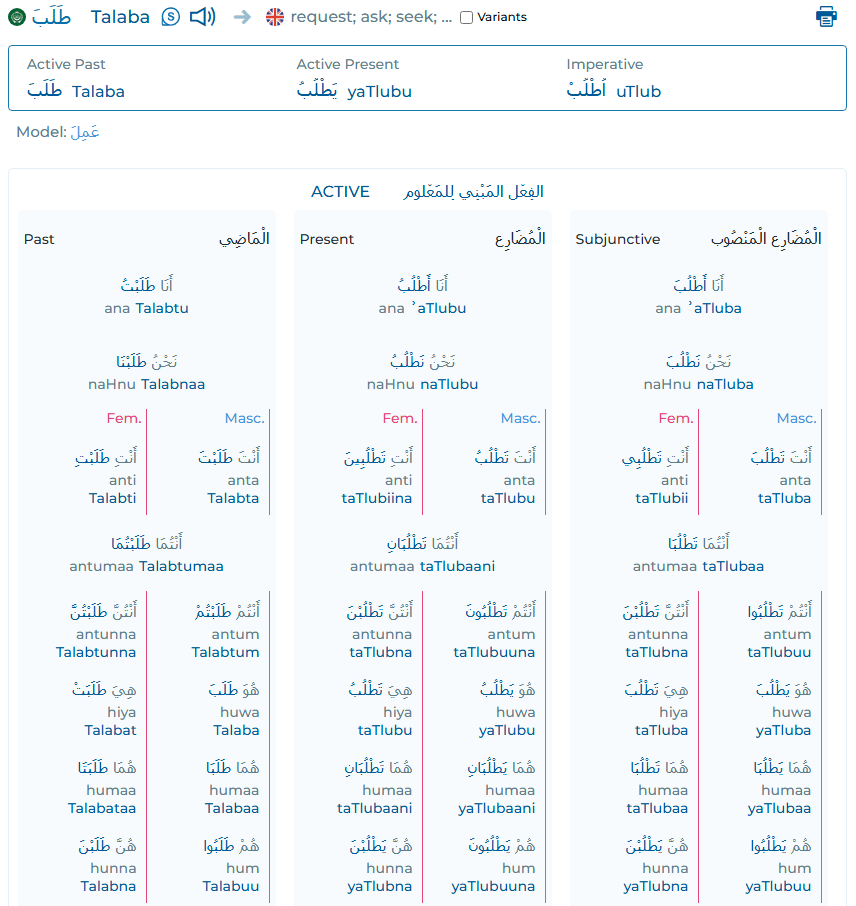
This feature of transfixation is generally not known to exist beyond the Afro-Asiatic language family, though with the example of Hausa, this phenomenon is not restricted to just within the Semitic languages. Through my experiences in learning Arabic, I have come to appreciate how the combination of the Semitic root and the transfix has yielded a diversity of derivative words and patterns, and learned how to make use of an Arabic language dictionary.
In addition to the mention that this is my most favourite morphological feature, I am also inclined to say that this is the feature in Arabic that I wish I knew more about back when I was studying Arabic. Perhaps knowledge of how this part of Arabic word formation works would have made my experiences in learning Arabic a bit smoother, as opposed to rote memorisation of words without appreciation or awareness of this very prevalent feature in Arabic.
Further Reading
Bennett, P. R. (1998) Comparative Semitic Linguistics : A Manual, Winona Lake, Eisenbrauns.
Idrissi, A., Prunet, J., Béland, R. (2008) ‘On the mental representation of Arabic roots’, Linguistic Inquiry, 39(2), pp. 221-259.
Lahrouchi, M. (2010) ‘On the internal structure of Tashlhiyt Berber triconsonantal roots’, Linguistic Inquiry, 41(2), pp. 255-285.
Lipiński, E. (2001). Semitic Languages: Outline of a Comparative Grammar, Peeters Publishers.
Ussishkin, A. (1999) ‘The inadequacy of the consonantal root: Modern Hebrew denominal verbs and Output-Output correspondence’, Phonology, 16(3), pp. 401-442.
Introduction to Arabic roots – https://wahiduddin.net/words/arabic_glossary.htm

