The Indo-European language family is generally not known for its use of phonemic tones. Languages like English, Pashto, and Albanian generally do not distinguish between words by tone, in contrast to non-Indo-European languages like Thai, Hmong, and the Triqui languages. However, what is more well known is the fact that there are languages within the Indo-European language family which have developed a form of the so-called ‘pitch-accent’ systems. In brief, this is a restrictive tone system where certain syllables within a word are made prominent, and this prominence manifests in the form of a contrasting pitch. While not fully tonal, these languages do indeed distinguish certain words or phrases by this system of marked prominence. Such languages most famously include Swedish and Norwegian, and perhaps less so, Serbo-Croatian.
However, there are indeed exceptions to the norm. And so today, we will look at some of the more well-known examples of languages from the Indo-European language family which have gone on and developed a system of phonemic tone.
Most of these languages are primarily spoken in South Asia, particularly in countries like India and Pakistan. These languages belong to the Indo-Aryan branch, a collection of at least 200 languages spoken by a total of at least 1.5 billion native speakers, spanning from Pakistan to Bangladesh, from Jammu and Kashmir to Sri Lanka and the Maldives. However, amongst the 200 or so languages in this branch, there are only a dozen or so of these languages which have been attested to develop a full tonal system.

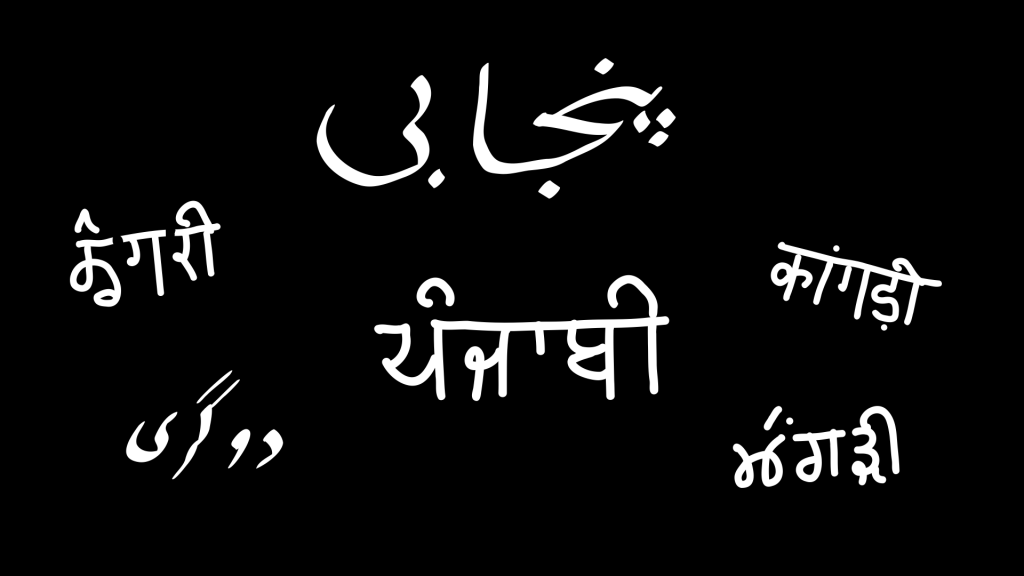
One of the most prominent examples of tonal languages here is the Punjabi language, a language spoken mostly in the Punjab region straddling India and Pakistan, as well as a rather significant Punjabi diaspora across the world. Together, there are more than 150 million native speakers of Punjabi, making it the most commonly spoken tonal Indo-European language. And so, today’s discussion will mainly revolve around the Punjabi language, although we will cover several other examples thereafter.
Other examples of tonal Indo-European languages include the Kangri and Dogri languages, which belong to the Western Pahari branch of languages, and are spoken predominantly in Himachal Pradesh and Punjab, and Jammu (in Jammu and Kashmir), Himachal Pradesh and Punjab respectively.
These languages generally share a common pattern of tonogenesis, although how these tones are assigned differ from language to language. Looking at the more discrete classifications of these languages, we also see that phonemic tone here generally arises through multiple independent events. We will focus mainly on tonogenesis in Punjabi.
In many languages spoken in northern India, there is usually some distinction by aspiration in the voiced consonants, with this distinction being reflected in their respective writing systems. This includes the bh, dh, jh, and gh sounds. This [h] sound, which may be referred to as the aspirant, would become a point of tonogenesis in the Punjabi language, and all voiced consonants, including the voiced glottal fricative consonant, would be where a tone could arise. We do not really know when precisely tonogenesis would have taken place, though the history of the Gurmukhi script, which has distinct characters for voiced aspirated consonants, would suggest that tonogenesis could have taken place at some point between Gurmukhi’s development and the recent past.
The tonal consonants of Punjabi would include the voiced aspirated plosives like those mentioned above, the voiced glottal fricative consonant, as well as voiced consonants followed by the [h] sound. However, there is an inverse relationship between the realisation of this [h] sound and tone. In other words, the more the [h] sound is realised, the less tonal the syllable would sound. This would depend on the variety of Punjabi, as some varieties sound considerably less tonal than others. Some varieties might also devoice the tonal plosives when these sounds occur at the start of the word, such as ghar sounding like kàr (house). The extent to which a tone is realised may also depend on emphasis as well, as tones may be reduced when that word is emphasised.
Punjabi tonal consonants usually carry a rising tone on the preceding vowel, and a low or falling tone on the following vowel, and is always induced on stressed syllables. On unstressed syllables, tone may or may not even be realised at all. Some sequences, especially with vowels before or after the /h/ sound, may change the vowel quality realised, and an unstressed ah sequence occurring at the end of the word can even be lengthened and nasalised. Other sequences may result in the assimilation of a vowel into another as well. While Dogri follows a generally similar pattern of tonogenesis, the Kangri language has not lost the distinction in voice and aspiration for tone to the same extent found in Punjabi and Dogri.
So, this has been a little introduction to how tones may have arisen in the few Indo-European languages that have them. In short, these tones generally arise from the loss of aspiration in voiced consonants, and these tones are mostly predictable, with them always occurring on stressed syllables. This may sound like other restrictive tone systems in other languages, which assign tones or tonal distinctions on stressed syllables. However, unstressed syllables may also carry tone, which may suggest that languages like Punjabi, Dogri, and Kangri are indeed tonal languages, instead of languages with restrictive tonal systems. There are several other tonal Indo-European languages we have not mentioned here, but most of them are spoken in the same general region, and belong to the Indo-Aryan branch of languages as well. Thus, we could expect that the patterns of tonogenesis in these languages to be similar, or at least share some similarities with that discussed today.
Further reading
Evans, J., Yeh, W.-C. and Kulkarni, R. (2018), Acoustics of Tone in Indian Punjabi. Trans Philologic Soc, 116: 509-528. https://doi.org/10.1111/1467-968X.12135

