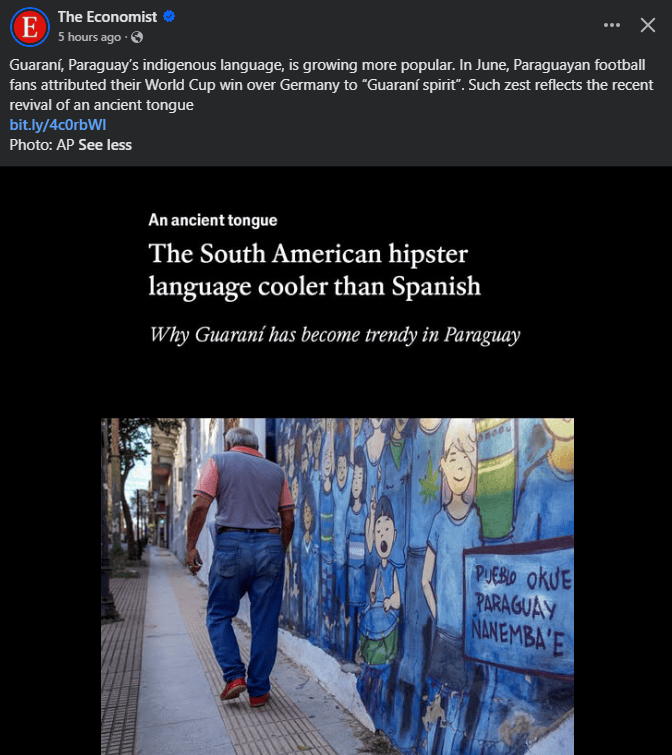
Just a few weeks ago (late-August 2026), I came across an article by The Economist which covered the Guaraní language, also known as Avañe’ẽ, which is one of the official languages of Paraguay alongside Spanish. However, the connotations attached to the increasing popularity in Guaraní seemed to be done pretty insensitively. After all, Guaraní is one of Paraguay’s indigenous languages, which for most of its post-independence history, has been subjugated under the Spanish language. Thus, to call the reclamation of Guaraní ‘hipster’ and ‘trendy’, when in fact the efforts made to achieve equal language rights with Spanish have been hard fought, would be disingenuous at best, and insensitive at worst. As such, I would like to dedicate today’s essay to Avañe’ẽ, and more specifically, Paraguayan Guaraní, and have a look into its history, its repression, and the situation today.
Paraguayan Guaraní is one of the 6 or so Guarani languages (such as Mbyá Guarani) spoken across South America, in countries such as Bolivia, Uruguay, Brazil, Argentina, and perhaps most significantly, Paraguay. With over 6 million speakers, Paraguayan Guaraní, which we will refer to as Guaraní (or Avañe’ẽ), is the most widely spoken amongst the Guarani languages. In fact, alongside the Quechuan languages, Guaraní is perhaps the most widely spoken indigenous languages in South America. Classified as a Tupian language, Guaraní is related to languages such as Nheengatu (Modern Tupi) spoken deep in the Amazon.
In Paraguay, only around 2.25% of the population identify as indigenous, with a majority of the population identifying as mestizos, or people of mixed European and indigenous descent. In fact, Paraguay has only around 75,000 Guaraní people, or also known as Abá, with Brazil, Argentina, and Bolivia home to more Guarani people. Yet, around 1.6 million reported using Avañe’ẽ as their main language, while a majority are bilingual in both Avañe’ẽ and Spanish. Comparing this with the general pattern of decline and loss of indigenous languages to the consequences of language shift and other attrition processes, Avañe’ẽ seems to stand out as having successfully resisted this shift.
It is not all sunshine and rainbows, though. For much of Paraguay’s colonial history, Avañe’ẽ had been the most widely spoken and dominant language, despite being a Spanish colony. Where Spanish colonisers would decimate and subjugate powerful empires in other parts of the Americas (most notably, the Aztec and Inca), colonisers and settlers had relatively amiable interactions with the Guaraní people, at least according to this article on bilingualism and society in Paraguay. Interactions with Jesuit missionaries would result in the first efforts made to document and preserve the language, resulting in word lists and early grammars of the Guaraní language. Interestingly, this would also result in the development of Classical Guaraní, a language variety of Guaraní primarily used amongst Jesuit missions during that period. It is perhaps most noted for its resistance to borrowing loanwords for foreign concepts (especially those related to Christianity) from languages such as Spanish, instead coining these terms using the agglutinative nature of Guaraní word morphology.
This would all change in the mid-18th century, as the Jesuit missions would be expelled by Spanish colonisers, resulting in the abandonment and extinction of Classical Guaraní. With the royal decree issued by King Carlos III of Spain in 1770, Guaraní language rights were effectively erased, as use of the language would be suppressed, starting first in official contexts and schools. Language transmission would thus be largely limited to the home contexts, as people would be forced to be use Spanish.
After gaining independence in 1811, Paraguay would further repress the use of Avañe’ẽ, and ironically weaponised it to galvanise national unity in times of need, especially wartime. In any case, this repression resulted in the banning of the use of Avañe’ẽ by both students and staff in schools, while much of the population were primarily only educated in Spanish. It was not until 1992 when bilingual education in Spanish and Avañe’ẽ became mandatory, and Avañe’ẽ gaining language rights equal to Spanish under the Paraguayan constitution. Despite this legislation, there were conflicting attitudes in the population towards the Avañe’ẽ language, as speakers contended between passing it down to their children and future generations, and letting the language go in favour for languages regarded as more prestigious, such as English and Spanish.
Today, Paraguayan Guaraní has made movements into the digital sphere. Websites, web translation tools, and social media sites may support the Guaraní language. Over time, Guaraní would be propelled into a wider visibility in the international community, as international or global events such as the World Cup could shine a spotlight on what makes Paraguay so unique, for instance. In the digital age, it would be possible that Guaraní would continue to stay relevant in public discourse, as the Internet would provide yet another domain of use of the language.
Amongst the youth, Paraguayan Guaraní is colloquially spoken as Jopara (mixture), wherein Guaraní and Spanish are used together in a process called code-switching. This infuses spoken Guaraní with loanwords of Spanish origin, and may even adopt Guaraní grammatical features in sentences that are predominantly Spanish, such as the evidentiality marker ndaje, which sort of translates to ‘it is said’. The rural and older populations tend to preserve more Guaraní features, with less borrowing of Spanish words compared to the speech used by urban and younger populations. Thus, the extent of mixture in Jopara depends on the age of the speakers and listeners, the place in which it is spoken, as well as the situation in which it is used. This forms a disparity between the Guaraní and Spanish taught in the bilingual education system, and the Jopara that is spoken amongst today’s youth.
Despite the Guaraní language attaining equal rights as Spanish in Paraguay, the Guarani people groups on the other hand still face obstacles in reclaiming their cultures and rights, such as the ongoing insecurity over indigenous land rights, access to public service and infrastructure, and discrimination. This is reflected in Paraguay’s census, such as the one in 2012, which recorded an illiteracy rate of 37.6% in the Guaraní people, and 31% of Guaraní people had access to electricity, and 15% had access to running water. A 2019 United Nations report also estimated that 76% of indigenous people were living in extreme poverty, compared to 4.41% of non-indigenous people. Looking at these disparities, and juxtaposing them against Guaraní language rights in Paraguay, one would start to ask, what is a language without its people?
While the title and hook seemed to depict Avañe’ẽ in a rather snobbish way by calling it ‘trendy’ and ‘hipster’, what the article by The Economist seemed to have failed to do is to truly recognise the linguistic trauma inflicted on the Avañe’ẽ language in much of Paraguay’s post-independence history, and that reconciliation and reclamation of the Avañe’ẽ language has been an ongoing process. What The Economist captured was the more recent drive to use Avañe’ẽ, and attributed the successes in Avañe’ẽ reclamation and revival to mere trends. This omitted elaboration on prior efforts in preserving and promoting the use of Avañe’ẽ in Paraguay, such as the development of Avañe’ẽ literature. When combined, I find that the article by The Economist did follow through with its title and hook to portray Avañe’ẽ as a mere ‘trend’, with some underlying implication that it would eventually die out as trends do. For a more well-written article about the linguistic situation of Avañe’ẽ, I would recommend the 26 August 2025 article in the Associated Press instead. The Guaraní language has been incorporated as part of the national pride of Paraguay, but the indigenous people groups who have used it for centuries and even millennia still face challenges ahead to attain equality with their non-indigenous and mestizo counterparts, and reclaim their traditional land and culture.

