For many languages with official status, more often than not, there would be some sort of standardisation of that particular language, at least to that country itself. In some non-English languages, this standardisation would center around the variety used in the capital or largest cities. For instance, Standard Japanese is developed around the Tokyo variety (and historically, Kansai varieties), and Standard Swedish is developed around the varieties spoken in Stockholm and other major urban centers. However, what happens when your official language has a stark abundance of varieties that makes the already complex process of standardisation even more complicated?
Today’s introduction focuses on the Norwegian language, a language with such a rich dialectal diversity, that there is no official spoken standard of the language. The official written forms, Bokmål and Nynorsk, kind of serve as ‘suggestions’ to what written Norwegian could be standardised as, but more often than not, spoken Norwegian will deviate from these written standards, with varying degrees depending on where in Norway you find yourself in.
In other major Scandinavian counterparts, Swedish and Danish have several dozen different varieties or dialects, with some gaining a stark distinction such as those spoken in Skåne and the island of Gotland, the latter of which being influenced by the much lesser known Scandinavian language called Gutnish. Norwegian, in comparison, dwarves these with its purported 1300 different dialects and varieties. So, how did we end up with so many Norwegian dialects?
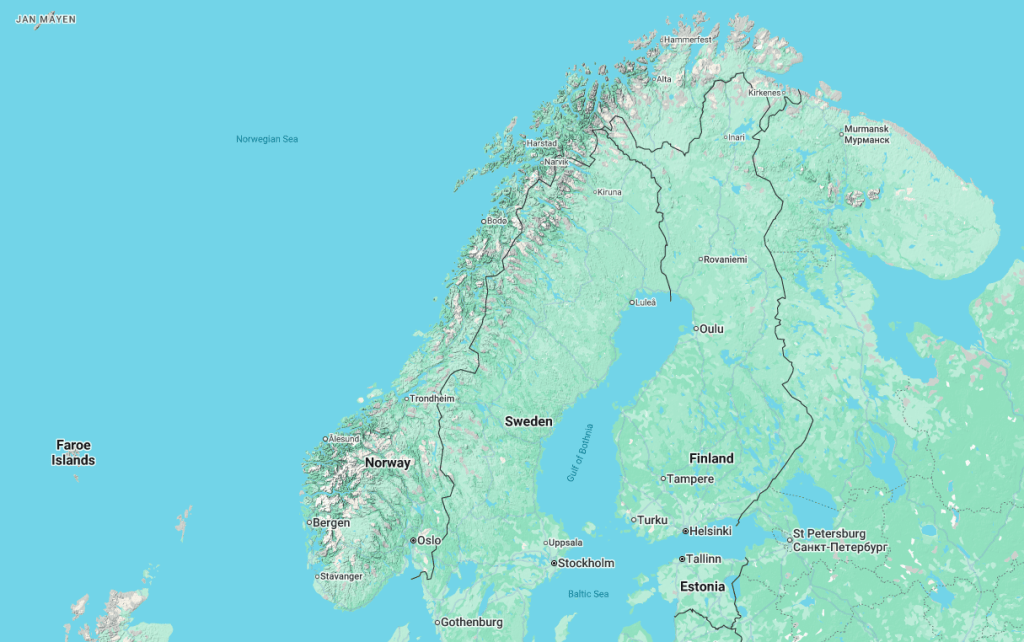
The first instinct would be to take a look at a map of Norway to understand the geographical factors behind Norwegian’s dialectal diversity. Norway has a pretty rugged terrain, with most of its inland regions being mountainous or at least hilly, and its coastal regions being heavily indented with iconic geological formations called fjords. This would have made transport between settlements before the advent of rail and aviation pretty complicated, and as a result, these settlements would have been rather isolated. Thus, local dialects would have sprung up over time, perhaps influencing one another in their vicinity. Nevertheless, speakers of various Norwegian varieties are able to understand one another, though there are some differences in pronunciation, accent, and lexicon.
Over time, as Norway developed its infrastructure to connect its many settlements both urban and rural, new varieties have sprung up in the communities around these centers. While they are unique, they are generally quite consistent with the characteristics of varieties in that respective region. Hydroelectric plants and railway stations have been documented as communities around which these novel varieties have developed.
With so many varieties, there would naturally be an immense challenge to devise an orthography to write Norwegian. In fact, this problem is so convoluted, that today, two different written standards are used to write Norwegian, and pretty much every single Norwegian variety deviates in some way from these written standards. So, how did we get here?
For a significant of Norway’s post-Viking history, most importantly, the 14th century to 1814, Norway existed under a union with the Kingdom of Denmark, and linguistic influences from Danish entered the Norwegian tongues spoken during that time. The written standard also took the form used in the Danish language, and remained so until Norway’s independence in 1814.
There have been several efforts to propose a way to write Norwegian, but ultimately, two Norwegian experts in languages eventually stepped up to the challenge, and succeeded. Ivar Aasen, from Ørsta, wanted to create a standardised form of Norwegian that was based on the varieties used in Norway’s rural communities and Old Norse, in contrast to the Danish-influenced varieties used in urban areas. This led to the development of Nynorsk (literally ‘new Norwegian’), used by around 12% of Norway’s population, mostly in the southwest. On the other hand, Knud Knudsen wanted reforms in the existing orthography to better reflect the varieties used by the educated and more urban speakers. This involved the incorporation of Norwegian phonology and words into the Danish system that was in place for centuries, creating the Bokmål (literally ‘book speak’) most of us are familiar with today. Used by around 88% of the population, Bokmål is the more commonly written standard for Norwegian, and if you have taken a Norwegian language course, this is the written standard you would be taught.
There are several ways one could pay attention to in order to work out which Norwegian dialect they are working with, and perhaps even figure out where they are. These mainly pertain to grammar, conjugations, pronunciations of vowels and consonants, and variations in certain commonly used words. For instance, the negation particle ‘not’, ikke (Bokmål) and ikkje (Nynorsk), would vary between regional varieties, such as being closer to inte and itte along the Swedish border in southern Norway (since Swedish uses the word inte), and ke in Narvik in the north.
In western varieties, the infinitive form of the verb would end in -a, -e, or lack an ending vowel, such as å bita (to bite) in the southwest such as Stavanger, å bite in Finnmark and Troms, and å bit in some communities in Nordland. In eastern varieties, however, some verbs can end in -a or -e, or -a or lack an ending vowel. Different words may be used to express the future tense, such as blir, kommer til, or skal. Some vowels may be diphthongs in some varieties, while some diphthongs may be monophthongs in other varieties. Perhaps more remarkably, like in Swedish, the restricted tone system in Norwegian would also vary from variety to variety. Try seeing if you can hear it when doing a road trip throughout Norway!
Nevertheless, Urban East Norwegian has been thought to be the unofficial spoken standard of Bokmål, at least in Eastern Norway. This is mostly spoken in the capital city of Oslo, as well as in Norwegian (as a foreign language) language courses. Nynorsk, on the other hand, does not have any spoken standard, official nor unofficial. With this diversity of Norwegian dialects, a speaker’s dialect would be respected as the pride of their place of upbringing and identity. However, as Norway has become better connected, local varieties may merge to form larger regional ones, as they lose more minor dialectal traits. As such, locals recognise the need to preserve their respective local dialects, and preserve the impressive dialectal diversity the Norwegian language has.

