In Scandinavian country banter, Denmark usually gets the short end of the stick by having the language everyone would make fun of. Several comedy videos have shown how garbled the Danish language sounds to Norwegian and Swedish speakers, and to much more hilarious effect, even fellow Danish speakers. If one thinks this cannot appear any worse for the Danish language, articles like this have pointed out that even Danish children have difficulties picking up their own native tongue. And so, today, we will take a look into what makes Danish so incomprehensible to fellow Scandinavian people, including their fellow Danish people.
As a brief introduction, Danish is a North Germanic language descended from Old East Norse, making it more closely related to the Swedish language than the Norwegian language, which descended from Old West Norse. Anyway, Danish, Norwegian, and Swedish are remarked to be largely mutually intelligible with one another, with Norwegian speakers getting the best of both worlds by being more able to understand Danish and Swedish.
Written Danish looks fairly okay, and one might suspect that this banter is overblown or overhyped. At a glance, the use of the letters æ and ø makes written Danish strongly resemble written Norwegian, and that it does not seem all that strange. Maybe some might say that it lures learners into a false sense of security, because sooner or later, the learner will have to contend with their biggest challenge yet, the speaker of the Danish language. This is where the difficulty skyrockets to some, and making some question if the Danish language is just made up.
For one, the Danish language is particularly known for the use of more guttural-sounding consonants, giving the impression that spoken Danish sounds like there is some throat problem. These pertain to the voiced uvular fricative consonant [ʁ], the voiceless uvular fricative consonant [χ], and to some extent, the voiced velar fricative consonant [ɣ]. These places of articulation, the uvula and the velum, are at the back of the mouth. Within a syllable, these tend to also be produced initially or after certain consonant sounds. Perhaps this prominence, and the lack of these sounds in Norwegian and Swedish, is why some might perceive Danish as being throaty.
Personally, I do not think that the guttural sounds remarked by learners form the only reason Danish sounds rather strange; there are several more layers to this. Guttural consonants do occur in other European languages as well. French is one example with [ʁ], also known as the ‘guttural-R’. Yet, French does not appear to gain a similar notoriety that Danish has, although French spelling does have its own issues that people would make fun of. Some varieties of German also use this [ʁ] sound, but this time, German has been generally perceived to sound aggressive (which I do not actually quite agree, having spent 2-3 years living in Germany). And so, I have put together three broad reasons on what makes the Danish language sound so unusual.
Stød
Where Swedish and Norwegian have a restrictive tone system, Danish has this feature called stød. There is no universal way of realising the stød, but in Standard Danish, based on the variety spoken in Copenhagen, it is usually realised as a creaky voice or laryngealization of a sound. Sometimes, this may also be realised as a glottal stop. The stød marks the distinctions between word pairs like hun – hund (she – dog) and even words that look the same, such as maler (painter – paints) and hænder (happen – hands). The stød appears in most of Denmark today, but there are some places where spoken varieties tend to sound more like a pitch accent, as in the varieties spoken in Southern Jutland. There are also places where spoken varieties lack a stød and a pitch accent, such as those spoken in Southern Zealand. Additionally, the Western Jutland variety has a separate preconsonantal glottal stop in addition to the stød, which makes things a tad bit more complicated.
The stød has been remarked to occur as early as the 16th century, when a Swedish bishop (of course), Hemming Gadh, noticed that spoken Danish carried a certain guttural cough. The stød mostly occurs in stressed syllables that end in a sonorant, a semi-vowel like /r/, /v/, or /j/, or the consonants /m, n, ŋ, l, ð/. And if you want to know more about the history and differences between the Danish stød and the Swedish and Norwegian pitch-accent systems, we have covered this is slight detail in one of last year’s essays.
Mergers and reductions
The Danish language is packed with at least 20 vowel phonemes, with 14 short vowels and 12 long vowels. This is slightly more than the 18 vowel phonemes Swedish has, and 17-19 vowel phonemes Norwegian has. Some analyses have suggested an upper end of 40 vowel phonemes, which is an absurdly huge number of vowels to work with. Thus, it has been suggested that substantially more work has to be done to distinguish between these vowels, although most of them seem to occur dependent on stress and neighbouring sounds.
What Danish has, however, is a tendency for these sounds to just merge with one another, or to disappear altogether in some words. For instance, the [øː] sound may merge with [œ̝ː] in some Danish speakers, and in a minority of Danish varieties, [uː] can even merge with [oː]. Long vowels, especially those in diphthongs (two-vowel sequences), are also subject to stød. These mergers vary between dialects, though this is nothing surprising in the grand scheme of dialectal variation, especially when Norwegian has a considerable number of spoken dialects and varieties in contrast to Danish.
There is also the impression that spoke Danish seems to drop some syllables that are otherwise written, or that some sounds are just ‘eaten’. One feature this observation pertains to is assimilation, where the /ə/ sound is assimilated into other neighbouring sounds through various ways. An example is the fusion of the sequences ər, rə, and rər into /ɐ/, and the assimilation of the /ə/ sound into preceding long vowels.
Similar assimilation occurs when the /ə/ sound occurs with a sonorant consonant like /ð, l, m, n, ŋ/. Instead of assimilating into vowel sounds though, this combination makes the sonorant consonant syllabic, transcribed as [ð̩, l̩, m̩, n̩, ŋ̍]. If there are two applicable consonants, it is the second one that becomes syllabic. This makes words like hunden (the dog) be pronounced as [ˈhunˀn̩], and hundene (the dogs) be pronounced as [ˈhunn̩ə]. Sometimes, in casual speech, the /ə/ sound would just be entirely omitted after an obstruent. Through omissions and assimilations, it is pretty evident how spoken words seem to contain fewer syllables than their written counterparts.
Lenition is also a feature of Danish phonology. This is defined as the weakening of consonant sounds under certain contexts. In Danish, lenition mostly applies to the plosive consonants such as /p/, /t/, and /k/. When lenited, these plosives become voiced, which make them slightly more sonorous than their voiced counterparts. The implications of this will be explained a bit later, but anyway, these lenitions occur more extensively in Danish compared to Swedish and Norwegian. Other languages like Irish also feature lenition, thus this process is insufficient to explain the unusual quirks of how Danish sounds. More rather, as remarked by Danish linguist Hans Basbøll, it is the combination of these processes and features that form a ‘dangerous cocktail’.
With an abundance of voiced segments, syllable boundaries in the Danish language may also be blurred. As such, some words may sound like a syllable or two has been omitted. For example, the word lærere (teachers) appears trisyllabic, that is, having three syllables. If each syllable is articulated, we would get a transcription like [lɛːʌʌ]. However, in causal spoken Danish, the last two syllables would melt together, giving something that sounds like [lɛːʌ] instead. Similarly, badede (bathed), a trisyllabic word that may be transcribed as [ˈb̥æːð̞əð̞ə], may be reduced to just [ˈb̥æːðː]. In some analyses, as much as a quarter of all canonical syllables in the Danish language are not articulated at all in casual speech. Some purport that there would be more semantic information conveyed per unit time in comparison to Norwegian and Danish, but it would come at the cost of a higher burden to process this information, which might require inference from spoken context.
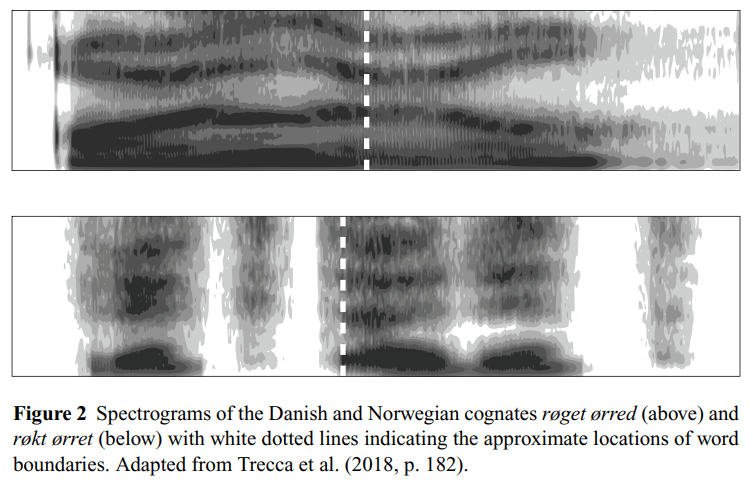
Prosodic and other phonetic processes may lead to the blending of different Danish words into each other, resulting in a perceived difficulty in distinguishing where word boundaries lie. Comparing this to spoken Norwegian like what Trecca et al. (2021) have done, Danish does seem to be rather mumbled, where Norwegian sounds more or less crisp with word boundaries being easier to distinguish.
There are also more phonetics things to discuss, such as the Danish Opacity Hypothesis, which tries to explain the effects of phonetically reduced speech on learnability and processibility of the Danish language. It remains to be assessed if there could realistically be social or pedagogical solutions to this challenge though. Nevertheless, the combination of these phonological features have most likely given the general perception of the Danish language being somewhat to rather strange.
Numbers
Anyway, banter of the Danish language is not complete without the unusual number system used here. While Swedish and Norwegian use a decimal (base-10) number system today, Danish uses a base-20 number system, with a rather similar number construction pattern with that of German. Some have remarked that Danish numbers appear like a blend of French and German systems with some Nordic words on top, and that description is pretty apt.
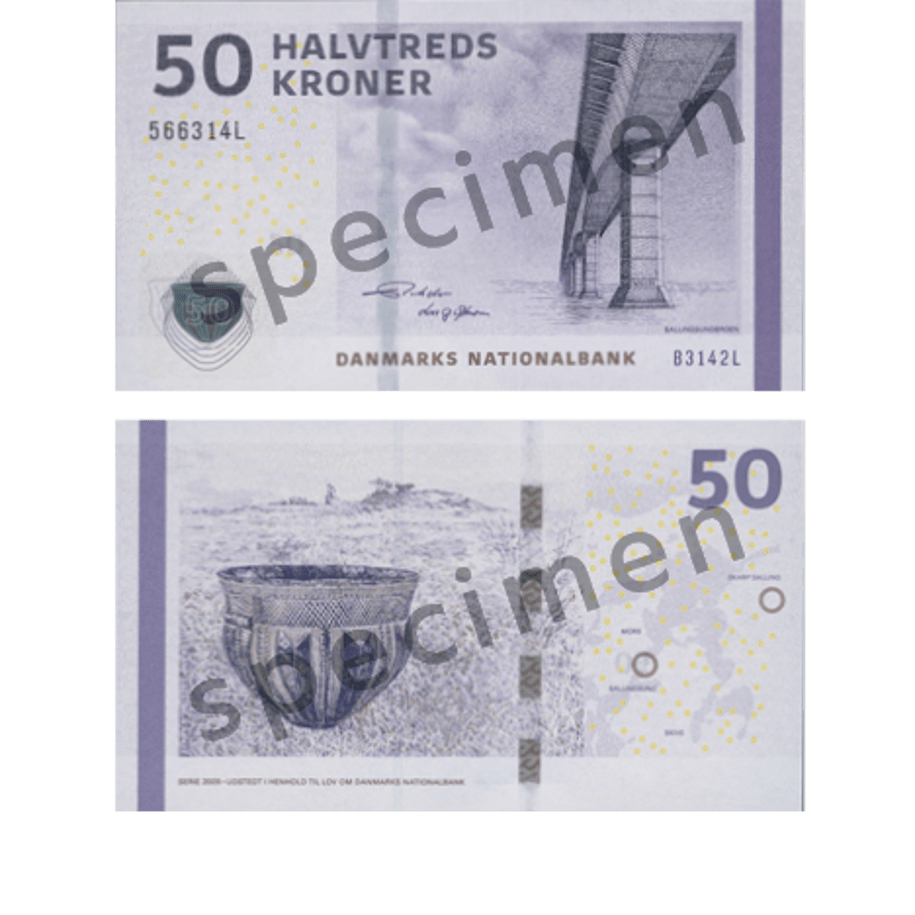
Unlike the base-20 system used in French, with words like soixante-dix and quatre-vingit-dix for 70 and 90 respectively, the Danish base-20 system uses the fraction half. For instance, halvtreds (50). This is broken down into half of the next score, or 20. Thus, halvtreds, short for halvtredsindstyve, would be broken down into (3 – 0.5) x 20. It is unclear why the base-20 system is used in Danish in contrast to the decimal in Swedish and Norwegian, but perhaps relative proximity to francophone countries like France would have opened Denmark up to language contact more extensively than Norway and Sweden.
And just like the German number system, number such as 21 are expressed as ([hundreds] +) [units] + [and] + [tens], as einundzwanzig (1 + 20) in German, and enogtyve (en + og + tyve) in Danish. This form of number construction is unusual amongst the languages of the world, which tend to go from the largest denomination down to the smallest. Swedish and Norwegian, on the other hand, would just use 20 + 1, tjugoett and tjueén respectively. When used in combination, such as 79, this number would be broken down in Danish as 9 + (4 – 0.5) x 20, or nioghalvfjerds. So, with the combination of the French and German systems, Danish numerals do get the distinction of having the most unusual number system in the languages of Europe.
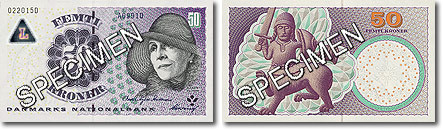
There had been a use of the decimal system for banking uses, and there was a time when the Danish krone (DKK) once had a 50 DKK note that printed the decimal form instead of the base-20 form. The 1997 series of DKK banknotes featured the 50 DKK note printed as femti, in line with the decimal words of the same number in Swedish (femtio) and Norwegian (femti). This, however was changed in 2009, when the new 50 DKK notes used halvtreds instead.
The combination of unusual phonological features and words would give the general impression that the Danish language sounds rather weird. Perhaps one of the more striking implications of this is how the Danish language is acquired by children in Denmark, as remarked by researchers such as Fabio Trecca. My first impression of the article in the introduction was scepticism, as I had thought that the content might have been sensationalised to attract traffic and interaction. But upon reading more about the backing journal article and review, it became clear to me that there actually is research being done to understand how Danish is processed, learned, and ultimately acquired. It also extends further to talk about processes of language acquisition, which is something I would be interested in covering at some point. In any case, while we may laugh at the skits and jokes about the Danish language, perhaps this essay has summarised why this might be the case.
Further reading
Basbøll, H. (2005) The Phonology of Danish, Oxford University Press.
Ejstrup, M. & Hansen, G.F. (2004) Vowels in regional variants of Danish, Stockholm, Department of Linguistics, Stockholm University.
Grønnum, N. (2005) Fonetik og fonologi, Almen og Dansk (3rd ed.), Copenhagen, Akademisk Forlag.
Trecca, F., Tylén, K., Højen, A. & Christiansen, M.H. (2021) ‘Danish as a window onto language processing and learning’, Language Learning, 71, pp. 799-833.

