Lately, I have been fascinated with the British game show Countdown, which features word-forming and arithmetic rounds between two contestants. Presented by Colin Murray, and co-presented by Rachel Riley and Susie Dent (in the Dictionary Corner) today, Countdown is one of the longest-running British game shows, and the British version of the French original Des chiffres et des lettres (Numbers and Letters). Aside from the rather interesting arithmetic mechanics featured in its Numbers rounds, its Letters and Conundrum rounds are also something of note, as they feature strategies that make use of word-forming patterns and restrictions of the English language. For now, let us focus on the Conundrum bit.
Conundrum is usually played as the final round between the two contestants, as they are presented with a 9-letter puzzle to unscramble. This 9-letter combination of letters may be presented in the form of a concatenation of 2 or 3 words, like REPELCOAT (which unscrambles to PERCOLATE). Contestants are given 30 seconds to unscramble this, the standard time limit in each of the Numbers and Letters rounds, but only one guess. If one of them guesses it correctly first, 10 points will be awarded to the winner of the Conundrum puzzle. On an incorrect guess, the contestant will be frozen out of the round, with the remaining time left for the other contestant to solve.
A variant of Conundrum presented to viewers of the television show is the Teatime Teaser, which features an 8-letter puzzle to unscramble, presented as a combination of 2 or 3 words. This is usually used in a sentence by the presenter, which adds further context and hints to unscrambling this puzzle. But generally, similar strategies may be employed in solving these word puzzles.
So as a language enthusiast, this got me interested. The feature of anagram solving is a rather intriguing topic in words and word-forming, as it exposes patterns in which English words may be formed, or restrictions in which letters could go together. Unlike Wordle, though, I have found myself struggling in some Conundrum rounds, while finding others quite intuitive. Inspired to do better at such rounds even though I do not see myself actually participating in these televised game shows, I decided to look into the strategies contestants have used before.
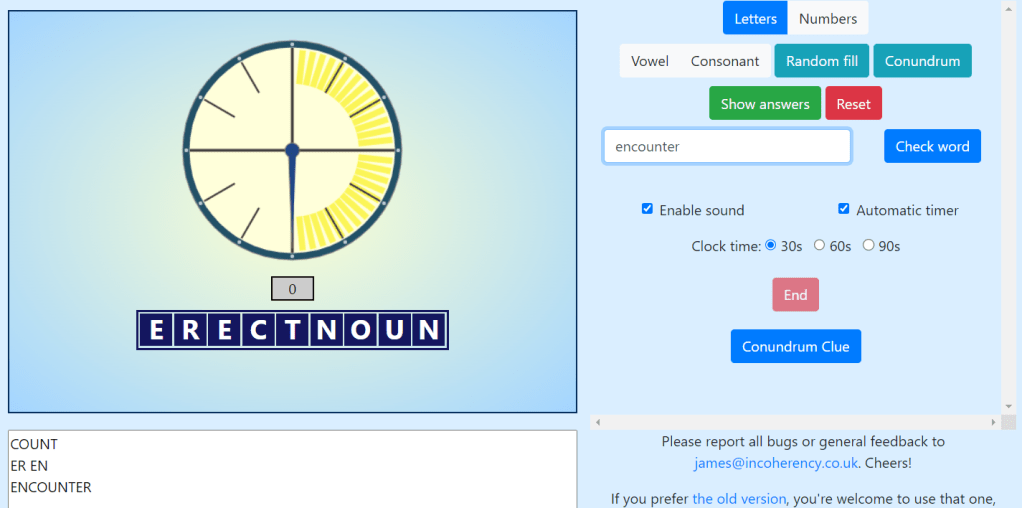
My first step was to identify what kind of letters could potentially go together, like consonant clusters (STR, SPR, and TCH), for example. Q must always be followed by U, X usually goes with an E (like EXERCISED), and L might just go with Y if the Conundrum is an adverb, like CAREFULLY. If C and K appear in the puzzle, there is a chance that they would go together. One of the more confusing letters to me is the letter V, as it could belong to suffixes -SIVE and -TIVE, but also trip me off and wind up solving to VINDICATE.
This leads me to the prefix and suffix strategy. By identifying letters that could potentially be separated from the others as a suffix or a prefix, it leaves behind fewer letters to unscramble to determine the word stem to which these affixes are added. Some might identify -ABLE, -NESS, and -TION, or even OVER- and UNDER-. But there is a whole lot more to identify, as compiled in this spreadsheet here.
But then we get to the letter combination -ING, the suffix that forms the present participle from a verb root. It was listed in the spreadsheet as one of the most informative suffixes, yet some Conundrum rounds do not make use of that suffix despite having those letters. What is going on then?
This was the point at which I learned how Countdown tournaments are structured. According to Countdown Resources, -ING is a rather common suffix when played in the heats, but more often than not, a red herring when played in the finals and Championships of Champions, where the 16 best players since the previous championship play for another knockout tournament. In these upper echelons of competition, these contestants would be required to identify potential red herring in these puzzles, making -ING one of the most prominent examples of traps put in place in Countdown Conundrums. As such, one of the tips for such rounds is to solve these anagrams, perhaps drawing hints from potential suffixes or prefixes, but excluding the -ING.


But what about words that solve to GUILLEMOT, SPIRULINA, or CHARLOTTE? These are generally names or names of species that happen to be 9 letters long, but generally lack the affixes we would normally expect to see. REPECHAGE is also another word I was not expecting to get intuitively, and the main piece of advice I found was to just practise.
Another observation was, some Conundrums have multiple solutions, but plurals of nouns like those ending in -S or -ES are not valid solutions, as with those verbs conjugating with -S or -ES in the present tense. Perhaps this could be used to help narrow down to the solution by eliminating these suffixes. Maybe this rule is a bit different in the 8 out of 10 cats spin-off, as I have seen PAINTINGS as a solution in one of their episodes.
A common practise material I have seen is Apterous, which advertises itself as the top site to practice for Countdown. Another format is Ascension, where letters are given in an ascending alphabetical order. I will give both of these a go at some point, and hopefully expand my abilities in unscrambling anagrams of 9-lettered words. The anagram feature of Countdown’s Letters, Conundrum, and Teatime Teaser is worth taking a further dive into, and we might just look into its Letters round in a future post at some point.
 The Language Closet