Most writing systems we read and write with today are normally written horizontally from left to right and some from right to left. But we have some of the more unconventional writing and reading directions, such as the Hanunó’o script which is written vertically from bottom to top. Today, predominantly vertical writing systems form a minority of writing systems, but represent an iconic part of the respective language and culture they represent. As I am currently learning Mongolian more intensely, I thought it would be great to shine the spotlight on the traditional Mongolian script, one of my most favourite writing systems yet somehow, close to a decade since starting The Language Closet, I have yet to properly introduce.
Mongol bichig is immediately derived from the Old Uyghur alphabet, which ultimately finds its roots in the Aramaic alphabet. Sogdian communities along trade routes that linked Europe and East Asia would play a prominent role in the spread of their writing system, the Sogdian script, into the Turkic cultures. Over time, the Sogdian script would be made cursive as well. While the Sogdian script was traditionally written horizontally from right to left, much like Arabic, by the time it entered use in Turkic peoples like the Uyghurs, the Sogdian script was rotated, reflecting the writing direction we see in the subsequent derivative writing systems. This would lead to the development of the Old Uyghur alphabet, which was in extensive use from the 9th century to the 13th century.
The early 13th century would bring about massive upheavals in Central Asia, with the Mongol conquests in Central Asia. Genghis Khan would lead the charge and defeated Turkic peoples inhabiting Central Asia, and capturing one Uyghur scribe named Tata-Tonga. This scribe would adapt the Old Uyghur alphabet for use in Mongolian of the 13th century, and introduce it to the Mongolian language, marking the birth of the traditional Mongolian script. Further letters would be added by a scholar named Ayuush Güüsh to represent foreign sounds such as those found in Sanskrit, Tibetan, and Chinese, creating the Galik alphabet in 1587. Additionally, the traditional Mongolian script would be adapted and introduced to the Manchu language in the late-16th or early-17th century as well. Further adaptations would be made to the traditional Mongolian script to be used in other Mongolian varieties, culminating in the Clear script or the Oirat alphabet in 1648 for the West Mongolic varieties such as Oirat and Kalmyk.
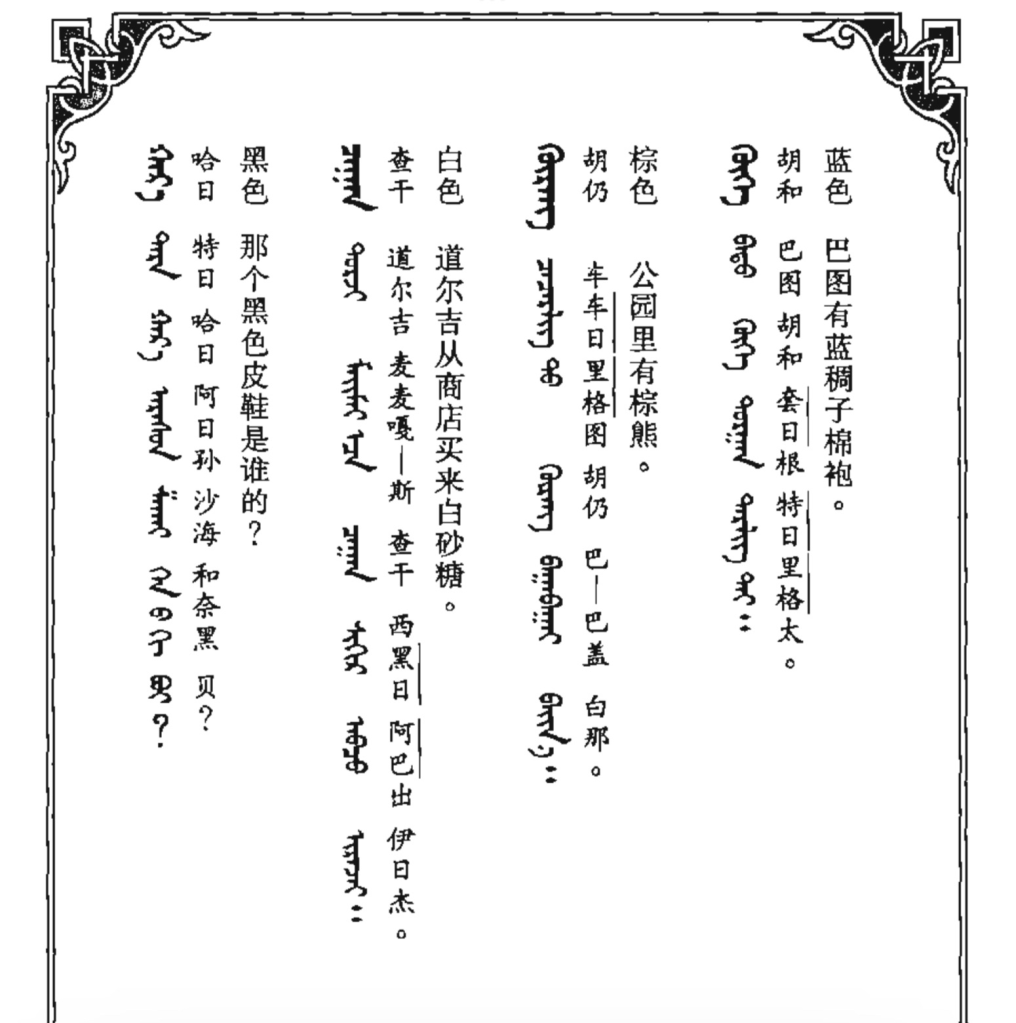
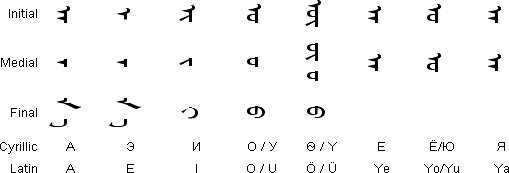
The traditional Mongolian script did not fully represent all the sounds used in the Mongolian language, perhaps even during the time when it was first introduced in the early 13th century. For one, while the Mongolian language distinguishes between the vowels o and u, and ö and ü, in the traditional Mongolian script, these vowel pairs use the same letter. Other examples also include the use of the same letter to represent the syllable-initial t and d sounds, and the k and g sounds, though context can help disambiguate this.
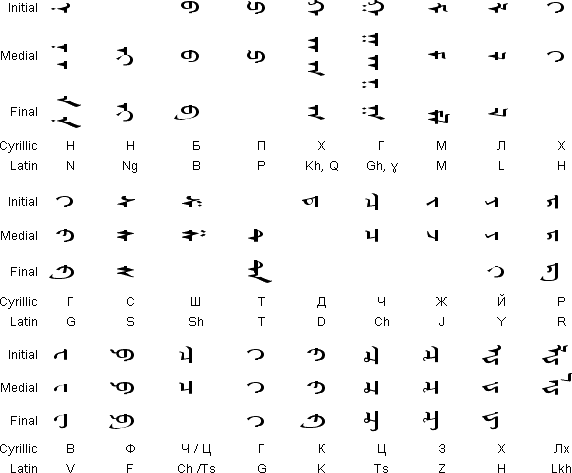
Although the traditional Mongolian script is an alphabet, writing is generally taught in syllables, such as the initial consonant-vowel and vowel-final consonant sequences shown in Study Mongolian. Nevertheless, initial, medial, and final forms of the individual letters do exist, and follow joining patterns rather consistently. Grammatical suffixes attached to word stems may be written separately, as in ᠡᠳᠦᠷ ᠡ (edür‑e, on the day). These separate forms may be more common in older texts, though these forms may help disambiguate otherwise similar-sounding words that would have been written identically.
Like Arabic, the traditional Mongolian script is written in cursive, and has distinct components and writing shapes to help get used to the constituent letters. Perhaps the most distinct patterns are the final tail (᠊ᠠ), crook (ᠠ), and bow (ᠢ) that mark the end of some words. Other shapes include the shin (ᠵ) with its many variations (like a loop, upturn, or downturn), and a stomach (ᠣ) or hind-gut (ᠲ). With the use of dots to distinguish some sounds, such as between the k (ᠬ) and g (ᠭ) sounds and the s (ᠰ) and š (ᠱ) sounds, and the cursive nature of the script, it would be understandable why some might say that the traditional Mongolian script looks strangely Arabic-like, albeit written vertically.
Several centuries later, Mongolia would come under strong political influence by the Soviet Union, ultimately forming the Mongolian People’s Republic in 1924. With this, would bring a drive to adapt the Cyrillic script for the Mongolian language, in an attempt to standardise and modernise the writing system to spur Mongolia’s low literacy rate at that time. While there was a proposal to use the Latin alphabet to write Mongolian, the Mongolian language would ultimately officially adopt the Cyrillic alphabet in 1946. This marked the beginning of Mongolia’s modern culture, with a stark increase in the literacy rate over time.
While Mongolia would transition to a democracy in 1990, the Mongolian Cyrillic script remained in dominant use. In this era, digitisation would present a new challenge to the traditional Mongolian script, as early computers were not really good enough to render writing systems there were not written from left to right, as well as cursive scripts. The traditional Mongolian script, written vertically in cursive, would have been a real challenge to computers early on, and so, the Cyrillic alphabet would remain in preferential use. Even today, the rendering of vertical scripts, especially when used alongside horizontal scripts, would present some formatting challenges as well. When Mongol bichig was added to Unicode in 1999, characters would be typed from left to right, then top to bottom, making text appear rotated anticlockwise relative to its correct written form. This rendering issue would still persist especially when Mongol bichig is typed alongside horizontal writing systems like the Latin alphabet. I am sure you have encountered several examples here already. Nevertheless, as technology improves, so too does support for unconventional writing systems like Mongol bichig. Some websites can now fully (and correctly) render text in the traditional Mongolian script, and in 2020, the Mongolian government would announce the use of both the Cyrillic and traditional Mongolian script to record official documents in 2025.
Today, there is a huge discrepancy in the use of Mongol bichig between communities in Mongolia and Inner Mongolia in China. In Mongolia, while students are generally taught how to read and write in Mongol bichig, the Mongolian Cyrillic script is still in widespread and dominant use today. Courses and textbooks on Mongolian in Mongolia, which centers around Khalkha Mongolian, typically only teach the Cyrillic script. Across the border in China, however, we see a much more widespread use of Mongol bichig, though the variety of Mongolian thought to be the standard here is the Chakhar Mongolian variety. Some Mongolian language resources from China that I have personally used when learning Mongolian only show the Mongolian script, with some additional transcriptions using Chinese characters. Nevertheless, Mongol bichig remains iconic to the Mongolian language, and is used in many cultural domains such as calligraphy and poetry in Mongolia and Inner Mongolia today.
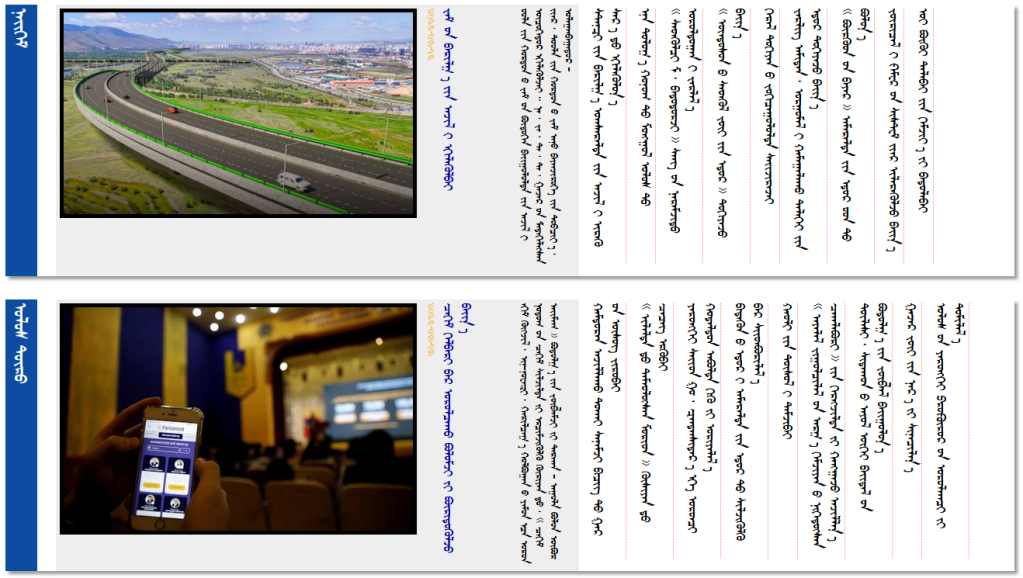
Some additional resources to learning or reading the traditional Mongolian script include the Mongolian language newspaper Хүмүүн бичиг сонин, as well as Study Mongolian. They have been a great reference to learning how Mongolian is written in this writing system, and so I would recommend these resources.
 The Language Closet