A while ago, we covered one variety of Low German spoken in East Friesland in northwestern Germany, that is, Oostfreesk Platt, or East Frisian Low German. Amongst the resources dedicated to learn this variety of the language, we briefly mentioned the application called PlattinO. Developed by Timm Sodtalbers, and artwork done by Nicolaus Hippen, PlattinO has garnered support by native speakers of East Frisian Low German and the Ostfriesische Landschaft, some of whom have contributed content and audio recordings to this application. And so today, following several months of continuous use of PlattinO, I am ready to present my thoughts on the application.
An overview of PlattinO
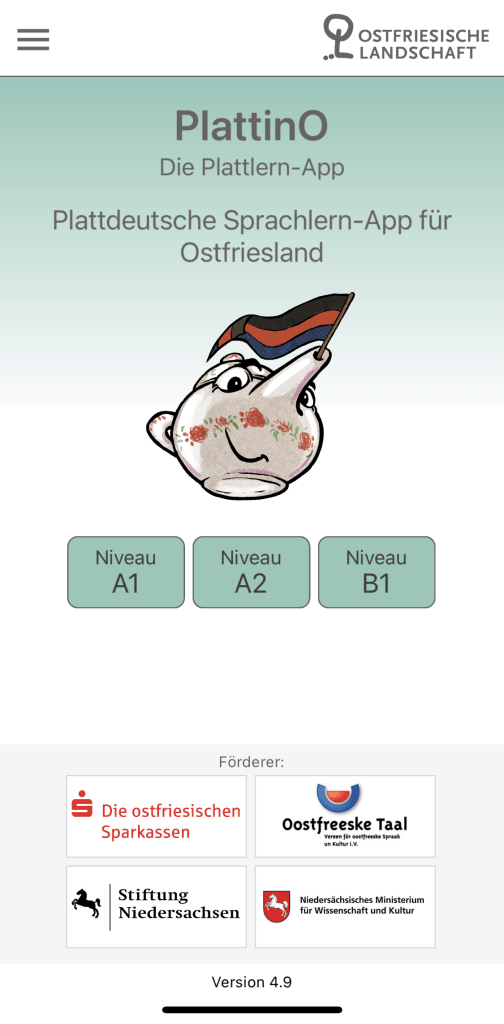
The 2010s marked the period of digitalisation of East Frisian Low German, with an online dictionary first released to the public in 2015. The development of PlattinO followed soon after, beginning in 2019, with its first release being in 2021. While its initial release only had content covering the basics and fundamentals of East Frisian Low German, getting learners to an A1 level, further updates added content for higher proficiencies. In 2023, an update allowed users to pursue East Frisian Low German to an A2 level, while in late-2024, a third and final update released allowing users to learn this language variety to a B1 level.
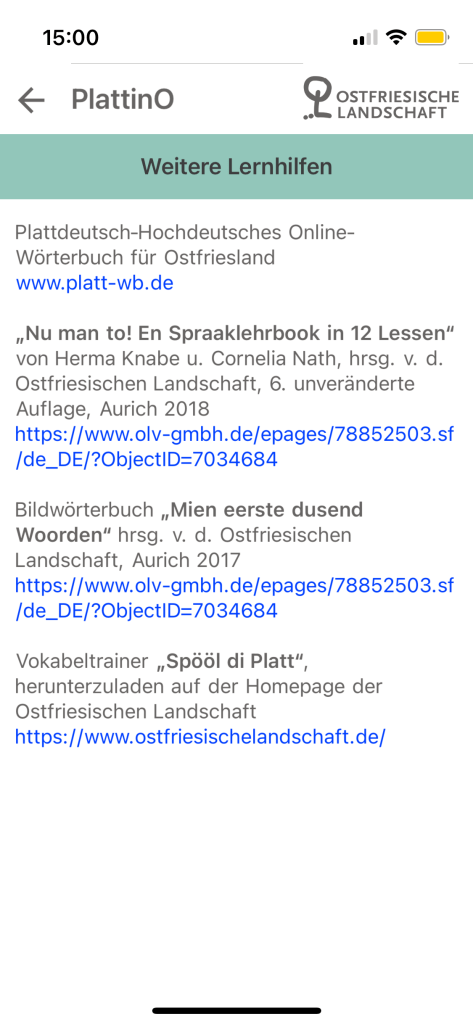
Interestingly, the application has also feature a small section that links users to further resources for East Frisian Low German. Like this application itself, these resources are also only available in German, so it would greatly help to pick up some bits of German while you are at it. It is perhaps one of the more special features for language learning applications albeit a rather minor one. This is because, having used and reviewed several language learning applications for endangered languages or languages with few readily accessible resources, PlattinO is perhaps the only one that actually directs the user or learner to further resources which could help in their learning experiences. As leaners of relatively obscure languages might remark, the availability and accessibility of resources could act as a little barrier to such experiences, so being able to see where to start or what to work with next as on PlattinO’s little section here is pretty nice.
Now, onto the main learning features of the application.
The overall structure in each proficiency level is roughly identical. Reviews are spaced quite regularly as well, at every four completed chapters. There is an Abschlusstest or a final test for the A2 level at the end of the course, but similar tests for the A1 and B1 levels are not available, just a review of the final four chapters. Individual chapters contain lessons featuring stories, and vocabulary segments pertaining to a certain theme, though there are some grammar pointers included in some sections as well. Each chapter is 28 pages long, which feature a small range of exercises for the user to try out.

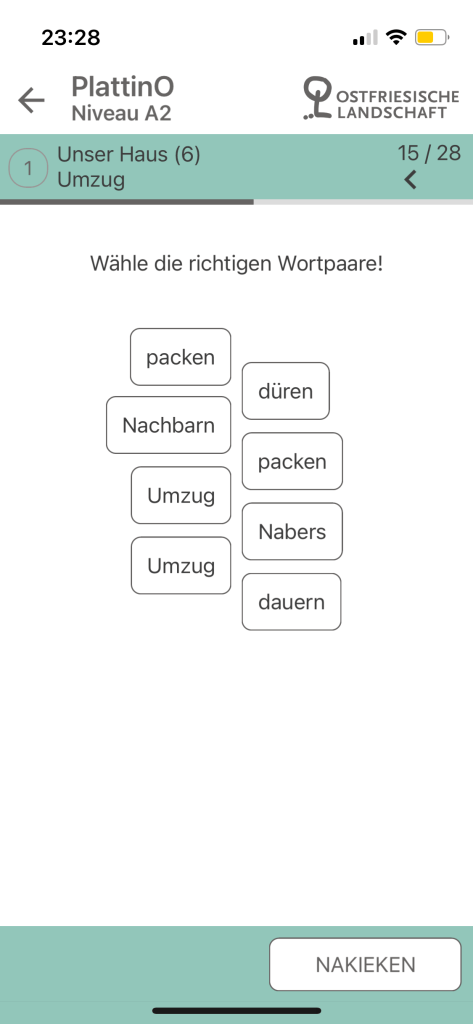
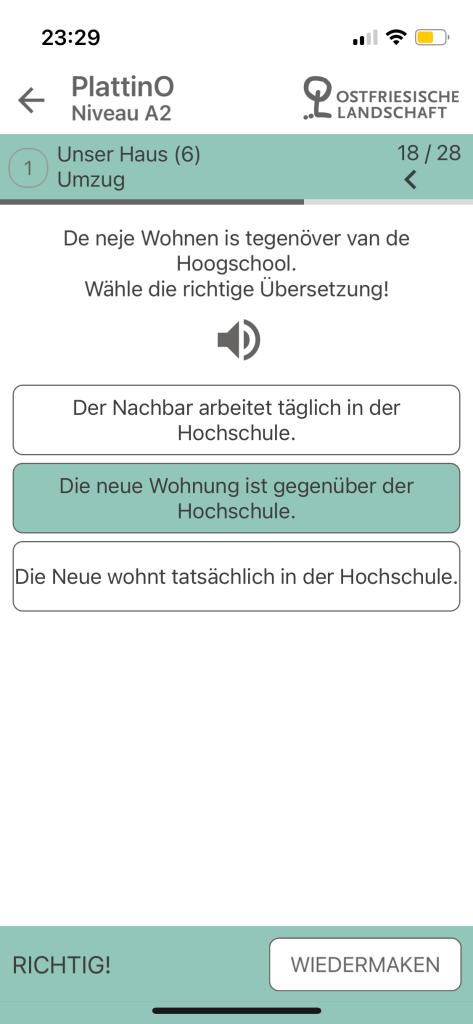
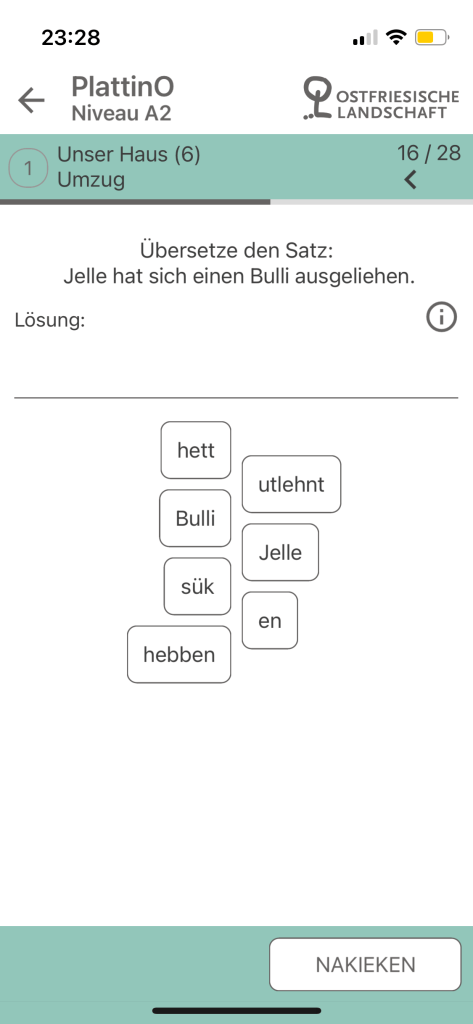
These exercises mainly serve to familiarise the user with words in East Frisian Low German, which can come in the form of matching word pairs or translating words. Sometimes, these exercises would involve the translation of entire sentences, or ordering word blocks to form East Frisian Low German sentences. From what I can tell, there does not seem to be an algorithm to practice words one is weaker at, and there are options to play audio on some exercises to familiarise oneself with the pronunciations.
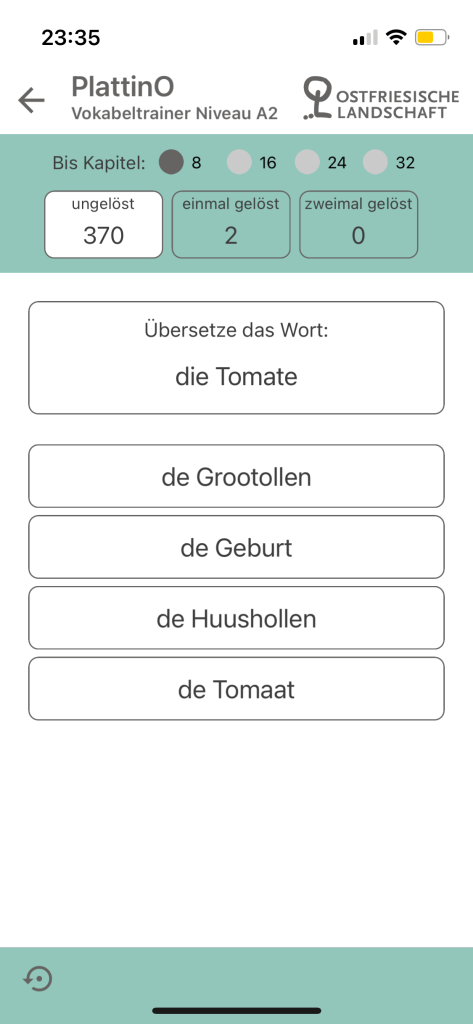
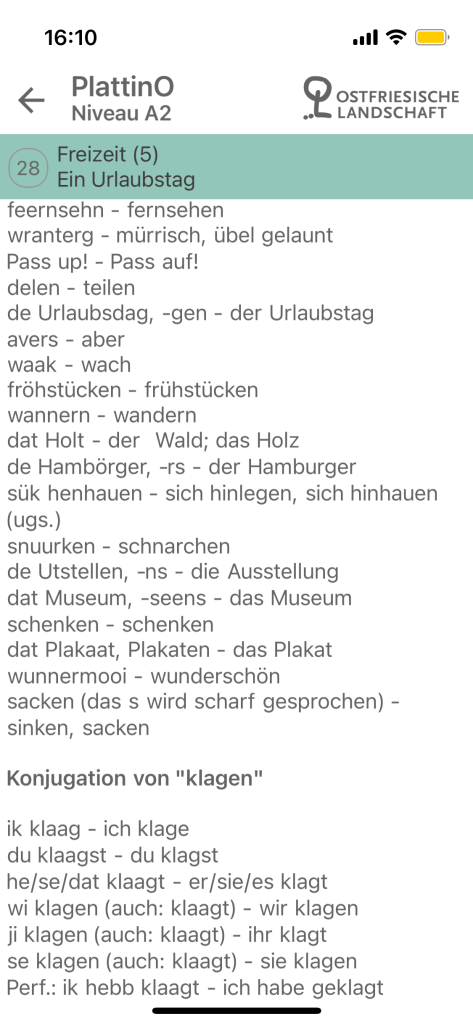
Tapping the Vokabeln tab on each chapter brings up a section detailing the words and verbs one would expect to learn in the chapter. These are purely textual, but provide some conjugation patterns for verbs in East Frisian Low German. Like pretty much the entire application, these word lists are bilingual in Standard German and East Frisian Low German, allowing the user to compare between the morphology of words between the two languages.
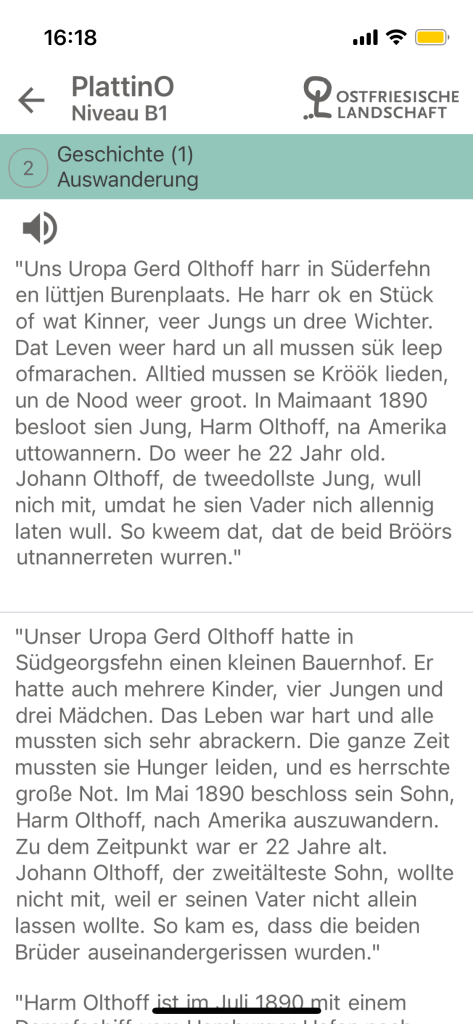
Furthermore, when the user reaches the B1 level, they will be presented with the option to select the option Texte that is presented on almost every chapter. This brings up a passage written in East Frisian Low German, with a corresponding translation in Standard German. Only the Low German has an option to playback the audio, and like some exercises in the application, provides the learner with an idea of how these words are pronounced, and how intonations occur on a sentence level.
Given the relatively regional niche that East Frisian Low German is as a language in Germany, it is understandable that entire resources like this platform are exclusively or almost exclusively in German. I hope that this could help drum up awareness and interest amongst the German-speaking population, and also learn about how diverse the German varieties can be. To international learners and users like I am, it has also been interesting to compare the differences in Standard German and East Frisian Low German words.
Personally, I am on the fence on whether or not an English localisation would be necessary for PlattinO, as even though having an English localisation is great to further reach out to international users who might not have competencies in German, it is also nice to learn a language through another language, as I have been doing for Northern Sámi in 2025, through Norwegian and Finnish. It could also be the case where the scope PlattinO had in that time did not really have international communities in mind as they prioritised outreach to Germans in that region or in German-speaking areas. I could see further localisations as a potential improvement to make, depending on the direction the Ostfriesische Landschaft prefers to take.
So, what do I think about all of this?
To me, I think that PlattinO is a great resource to pick up East Frisian Low German. Being available on mobile, with further directions to more resources about the language, the application is freely accessible, with no advertisements at all. It also deviates from conventional methods of learning a language, such as following a coursebook that may be complemented with a classroom lesson. While the upsides of learning a language through mobile applications would apply to platforms like PlattinO, their downsides would also apply as well. This can include a lesser emphasis on listening and speaking, as opposed to reading and writing.
There are also some downsides that could make this application a bit unappealing. For instance, PlattinO is visually lacking, with a rather heavy use of text in its lessons and exercises. While this is generally not the case in the A1 and perhaps A2 levels, the lack of visual aids in the Vokabeln tab or in many of their exercises would make the application seem graphically mundane, with potential implications on user retention to further pick up the language with PlattinO as compared to other competing methods.
Also, the application places a heavy focus on training and familiarising with vocabulary, and not so much on the grammar side of it. Perhaps one reason is, being a German application focusing on a variant of German dialects, the grammars could be argued to be functionally the same, especially at the proficiency levels covered in the application. As such, assuming the user has attained some experience in German, they would mainly need to pick up differences in conjugation or inflection patterns, especially in the verbs. To the international user though, it would undoubtedly be a good idea to learn some Standard German before beginning to pick up German varieties like Oosfreesk Platt.
With a declining use of the language in the younger generations, organisations like Ostfriesische Landschaft have been curating language learning methods such as PlattinO to garner interest in the language again. Thus, I see the importance of PlattinO to facilitate this process. Like Doyon Languages Online, there is also additional merit to allowing people from around the world to learn about East Frisian Low German, without having to resort to conventional classroom methods, which would mainly entail being physically in Germany. This platform is also a free and accessible resource to those who want to learn Oostfreesk Platt, lessening the burden on the learner to search hard for textbooks or other resources to learn it. For now, I am giving this platform a 7/10, but I will be keeping up with this application if significant changes are made, and make the necessary updates.
| The good | The not so good |
| Free, readily accessible without advertisements | Visually lacking in many exercises |
| Directs the user to further resources covering Ootsfreesk Platt | Heavier focus on vocabulary than grammar |
| Regular reviews of each chapter in a certain proficiency level | Due to scope and intended audience, the application is only available in German |
The Language Closet rating (2025):
And for a final section where conflicts of interest would matter in the review, I have not been paid to make this review, nor am I currently affiliated with competitor applications to write reviews for applications like this. These opinions are entirely my honest thoughts about the features and changes present in the application.
 The Language Closet