Previously, I have asked you readers if it is time for an updated Duolingo review, and you have responded resoundingly in favour of one. So, after some months of getting back on the Duolingo grind, I am back here, in 2024, to do an updated review of this language learning application giant. Firstly, I want to talk about the primary new features that have been added, before making some critical feedback on them. These would pertain to the format, language diversity, and changes to user experience.
The New Languages
As of 2023 and early 2024, there are several new languages offered by Duolingo. These languages tend to be generally less learnt, but are interesting nonetheless. Where we left off, the newest languages included Hawaiian, Navajo, and Finnish. This time, we have Haitian Creole, Yiddish, and isiZulu. Some learners might be interested in learning some languages from Africa, or learn about some languages that have evolved through creolisation, and I think that this is a welcome start. This brings the number of unique languages offered by Duolingo to 43, including Guarani for Spanish speakers, Catalan for Spanish speakers, and English. Interestingly, they have also added mathematics and music to the application, although for music, it seems to only focus on notation reading (on the treble clef), perhaps bringing you from the absolute beginner in music theory to pre-ABRSM Grade 1.
But recently, a more concerning update has occurred. isiXhosa has previously been in the works for some time, but that has since been axed in more recent updates. Xhosa was initially announced alongside Maori in 2021, but development in these course seem to have fallen through. I would have loved to see a Duolingo course in Maori, especially after having a great experience learning the language on other applications like Drops, and various books. Seeing Xhosa vanish from the language menu completely is a saddening sight to see, as that could indicate a similar fate with Maori.
Bringing these languages up through the incubator is extremely unlikely as well, since the community-led language incubator programme was terminated in 2021, as the application moved towards a more internalised process, citing the need to be standardised and meet shareholder expectations. This is largely attributed to Duolingo going public in 2021, which would complicate matters in volunteer-led programmes, profit, and standards and expectations set out by people who have bought shares in Duolingo. This would most likely mean that Xhosa and Maori could be gone for good, as Duolingo shifts its focus onto revamping and working on its currently available courses. It is extremely disappointing news, as we would have seen the development of courses in various indigenous languages such as Yucatec and K’iche’, and languages that are likely threatened with extinction, but have lost one of the largest platforms on which speakers could share their language.

The New Format
All courses now follow a more linearised path, rather than the limited choice tree we were so used to for so long. At the start of each unit, there are sample phrases in the grammar unit section which give learners an idea what the unit is about, or what they can expect to learn. While they call this a grammar unit, it does not necessarily show new grammar pointers in the content, which, in my opinion, kind of defeats the purpose of having it there in the first place. Some language courses omit this entirely, leaving learners to dive into the relative unknown. This might not apply to more commonly learned languages though.

Another thing I noticed was that pronunciation support or voiceovers were still incomplete for languages like Navajo, while some languages have more limited support for voiceovers like Haitian Creole. I think expanding voiceover support for Navajo would have been more welcome than what we have now, and it would be more helpful in understanding examples of Navajo phonology. While Duolingo is regarded as a far cry from understanding the practical use of the target language, especially in higher levels, the importance of translating from text on screen to sound is still there. They did it to some extent on Haitian Creole and Hawaiian, so why not Navajo?
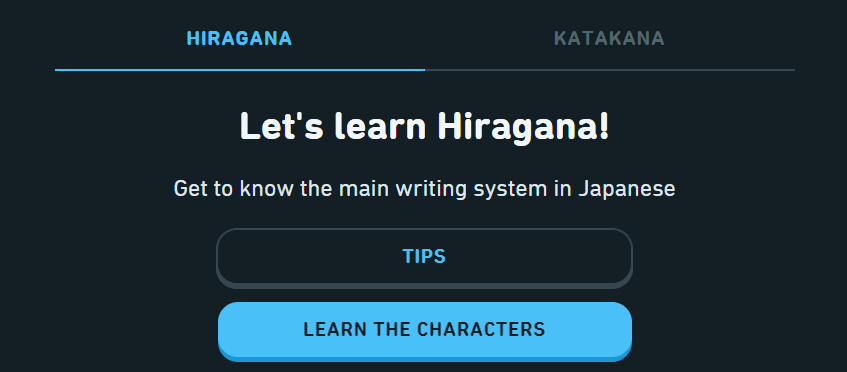

Interestingly, I think I might have missed out on something from my previous review. On language courses like Japanese, Korean, Arabic, Hebrew, and Yiddish, there is an extra section dedicated to learning the respective language’s writing system (or systems, for the case of Japanese). While basic, and occasionally, these combinations of letters do not really translate to anything meaningful, this form of rote learning does seem to effectively introduce the characters in the language’s writing system for learners to pick up, as no romanisation is provided in the exercises. Kanji and Chinese characters are learned during the course, however, which explains why there is no dedicated section in the Chinese course. I do not remember when this was added, but my best guess was when Tinycards shut down. Please let me know in the comments about when this change was made.
New Ways to Earn Experience
Beyond the usual exercise and practise grind you would normally encounter in an average session on Duolingo, there are now a couple more modes of exercises. Sometimes, these present as events in-application, but sometimes you would be prompted to try those modes out. These modes are Match Madness, and a timed trial.

Match Madness focuses on one type of exercise found in a typical Duolingo session. There are five words presented, along with their corresponding translation in the target language, with the order largely scrambled. The user is supposed to match the words correctly, but this time, within a set time period. This type of exercise, I am inclined to think, aims to train the user’s familiarisation between word and translation, and applying that connection more quickly and spontaneously.

The other type is a timed trial sort of thing. While a typical exercise could take anywhere from 2 to 5 minutes, the timed trial brings this duration down. Users are expected to go through a typical practice in typical Duolingo fashion, but with progressively shorter time periods, perhaps as short as a minute. I do not know what this aims to train, other than perhaps speedrunning a language course.
These special modes definitely bring slightly more diversity to the relative mundanity of “Write this sentence in [insert language here]”, and Match Madness seems to draw some influence from it long terminated Tinycards cousin. These also serve as alternative ways of earning experience, if you are heavily invested in the league tables, as the upper difficulties could get you at least 4 or even 8 times the experience you normally earn from a normal practise. Personally, I have found myself addicted to Match Madness, and perhaps shot through the weekly leaderboards in some occasions. These are definitely welcome additions to bring more variety in activities to do, especially if you are drained, bored, or fed up with the normal exercises for the day.
Quests and Stuff
To encourage learners to build a habit to practice their target language, Duolingo originally had this streak challenge. This aimed to encourage daily practice to prolong or maintain the learner’s own streak. Over time, more systems were introduced to retain learners on their platform. The more significant additions of which included the league system, pitting learners against one another to get more experience in weekly leagues, where the top of the group would advance to the next league, while the bottom few would be relegated down a league.
The next additions came in the form of quests, with daily quests, quests with friends, and monthly quests currently implemented. Three quests are made open every day, involving accuracy, perfect practice, finding a said character during an exercise or practice (more luck-based), and earning experience. Completing each daily quest would earn the learner some gems, the in-application currency, or some experience booster that would double the experience earned in an exercise for a limited time.


Quests with friends are a more luck-based one, where completing an exercise would have a chance of triggering such an event occurring. While it is intended to be cooperative, by having learners earning experience together to complete the said quest, some quests are simple enough to be completed solo. Upon completion, the learners would earn gems or other kinds of boosts.
There seems to be only one monthly challenge available, which can include things like earning 1000 experience in a month, or completing a set number of quests in a month. The main reward for completing the monthly challenge is an exclusive badge that will be displayed on the badges tab in the application. Being exclusive, there is no other way to earn the badge if one fails the complete the challenge of the month. These mechanics thus aim to promote daily practice through giving rewards, which also aims to boost user retention on Duolingo.
But what do I think of it?
I think it does try to encourage retention on Duolingo, but once that streak is gone, like missing a day of practice, and if you are not willing to spend to freeze that break, there might not be sufficient motivation to continue practicing with Duolingo. These more varied exercises, and other side quests do indeed encourage users to try to go beyond that one exercise per day, and overall, I think it is a welcome feature to the application.
Glaring Issues
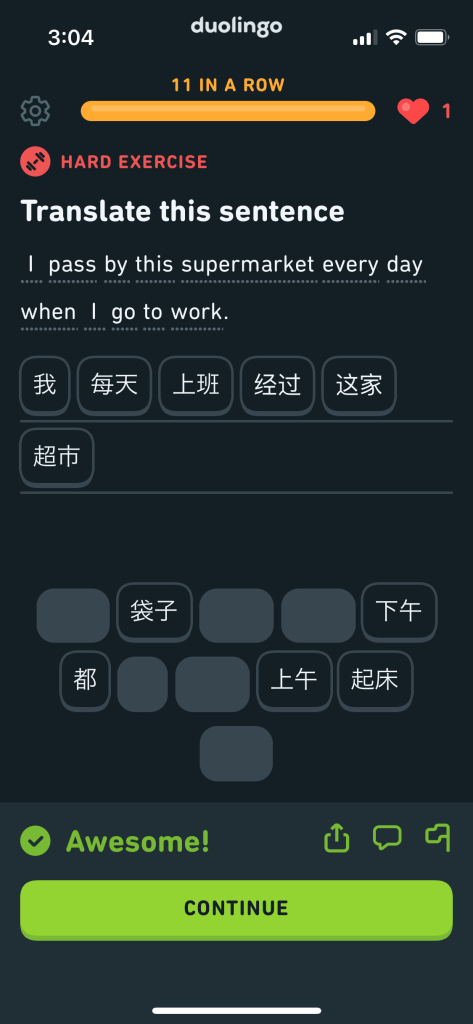
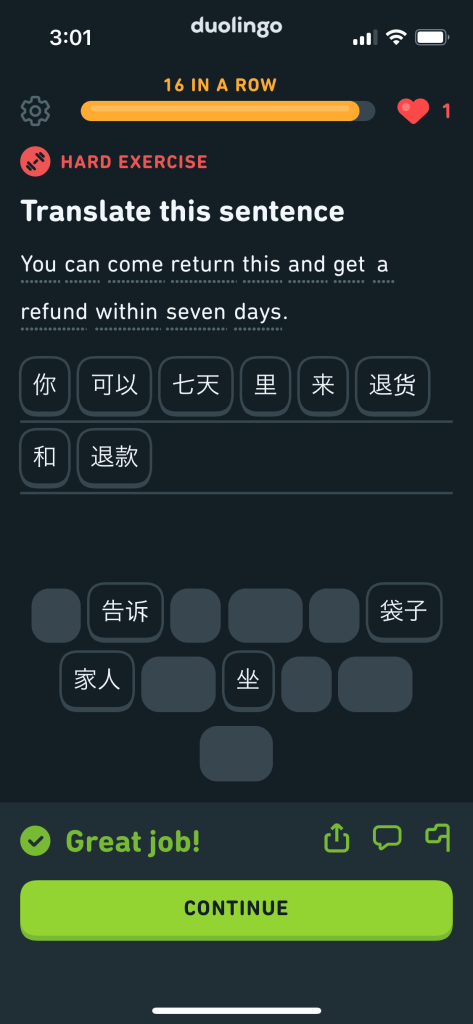
While some of the sentences tend to make more practical sense now, there is another thing that I hope Duolingo could strive to fix, that is, how natural some sentences sound. To show some of these issues, I turned back to Duolingo Chinese, since I am a native speaker of both English and Chinese. While most words covered in the course do translate well, the issue comes when grammar is involved. Some particles in Duolingo are dropped when it feels more natural to say it in a sentence, while others just do not sound right.
Take these two below, for example.
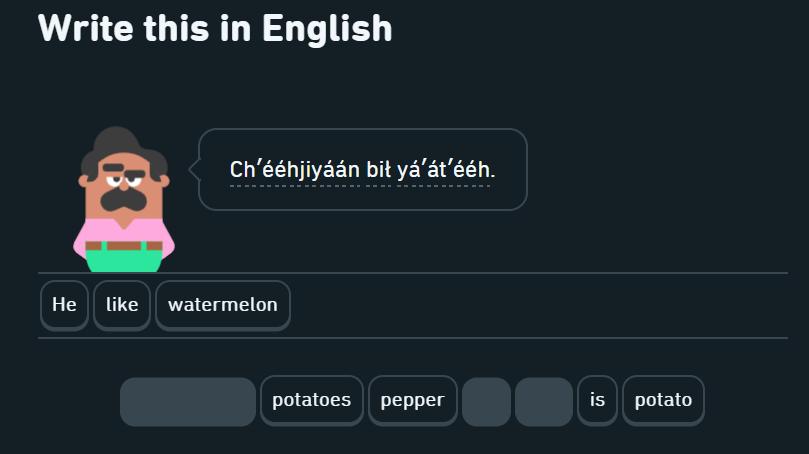
Another issue I encountered are more minor mistakes made during development. Take this exercise in Swedish for example. For some reason, the Swedish word for ‘she’, hon, is not even part of the option words when the user is not in keyboard mode. Perhaps it could have been an oversight, but issues like this are still there.


If you use Duolingo purely for free on mobile, you might also have noticed an ad playing every time after completing an exercise, regardless of success or failure. Its frequency felt way more often compared to what I remembered it to be, although some recall bias might be in play here.
While it is true that ads do help Duolingo stay afloat, the ads that play after each exercise tended to promote the premium version of Duolingo instead of third-party advertising (which just seems to be just fake mobile game ads), at least from what I have seen thus far. Overall, it does remind me of using Spotify on mobile for free, where an ad plays after almost every other song, creating a jarring user experience, and creating a pressure towards getting the premium subscription instead. Of course, it could be seen as a cash-grab to make Duolingo stay operational, although it comes at a cost of a smooth user experience to the end user.
Controversy regarding use of artificial intelligence in generating translations
Towards the end of December 2023, a discussion was posted in the Duolingo subreddit covering how Duolingo has laid off contractors dedicated to making translations for its various language courses. This move was speculated to be due to the pivot towards artificial intelligence and large language models in making translations, and having a reduced team to review this content as a means of quality control.
It is a concerning pivot, as it is interpreted as yet another way Duolingo is scaling back on its community involvement, as it has done in 2021 by pivoting away from their language incubator programme. But this involves the encroachment of artificial intelligence in areas related to human language and language learning. Issues would undoubtedly arise when a large language model is unable to grasp certain nuances in human languages, such as gendered languages, or certain forms of figurative speech.
Additionally, as languages continue to evolve, such models might be trained on increasingly outdated data, and in the long term, what is said today or the recent past could be antiquated in the future. If the language model is not allowed to train on newly available data for whichever reasons (like privacy), then Duolingo might just be increasingly unreliable as a language learning application, especially if certain language pairs are understaffed for quality control.
This unsurprisingly caused a stir even within the subreddit itself, with some suggesting to not support Duolingo Premium. Among these reactions, the one that definitely stood out to me was the undermining of the primary vision Duolingo started off with — to have native speakers cultivate content. We have seen this with the cutting back of the incubator programme, and now the push towards use of artificial intelligence. But there are some who have faith in this pivot, speculating that the quality of translations and pronunciations would improve.
The use of artificial intelligence in language learning is not new. After all, algorithms exist to identify areas that require further practise. But this push towards generated content is certainly novel, especially in the wake of other forms of generated media like Midjourney-generated images and ChatGPT’s various functions. The use of generated content has already stirred controversy in areas like art, music, and even script writing, often being criticised as soulless, as some might have seen in the Kwebbelkop controversy surrounding generated video and influencer content.
As this news is still relatively recent, I guess we shall soon see how effective this move is, as with the effects on Duolingo’s reputation among its user base and community. I would definitely keep my eyes peeled on updates, while paying attention to competing applications that may or may not be headed in the same direction.
The summary
To update the original Duolingo review, I am giving it a 4.5/10 now. The introduction of new languages to the Duolingo ecosystem is a welcome addition, but it sure has come at a cost of several aspects of user experience. The linearised approach to lessons rather than some form of choice, the ever present issues in some exercises, and the ad problem certainly has harmed the average user experience on its mobile application. The termination of the incubator programme, and the vanishing of the isiXhosa course from the language menu makes it seem that Duolingo is not looking to expand into developing new language courses soon. Looks like I will be sticking to competing methods like Drops for the time being.
| The better | The worse |
| More exercise formats | More linearised learning experience |
| New languages added, bringing more diversity to the platform | Persistence of some issues in lessons, including grammar particles |
| Daily quests, monthly quests, and weekly league tables encourage user retention on the platform | Advertisements that play after every exercise might be jarring to some user experiences |
| Farewell, language incubator programme |
The Language Closet rating (2024):
Perhaps we would see Duolingo move in the ratings as updates are rolled out over the course of the next year or two, but unfortunately, this is where I would personally rate it at in 2024. While Duolingo maintains its dominance as one of the largest language learning mobile applications, further care should still be taken to ensure that learners are still able to form meaningful learning experiences from the app.
And for a final section where conflicts of interest would matter in the review, I have not been paid to make this review, nor am I currently affiliated with competitor applications to write reviews for applications like this. These opinions are entirely my honest thoughts about the features and changes present in the application.
 The Language Closet
The Roman alphabet courses are easier. Hebrew and Korean are the most difficult. Very hard to learn the alphabet. You get asked to translate words from English when you have not yet learned them. Nonsense sentences. Instead of useful stuff like, where is the toilet, you get absurd sentences which most people don’t need, such as the witch is green or the giraffe is drinking coffee. My latest problem is that when I click on on the speaker symbol, before I can speak the screen moves on.
LikeLike
Pingback: Spanish Learners on Duolingo: How Many Are There? – My Blog