It is 2024, and some of you might still have “learning a new language” as a resolution for this year. You might have poured through the conventional mobile applications dedicated to serve this purpose. Duolingo, Memrise, perhaps you might have taken up Babbel through some of their sponsored marketing through some YouTube channels.
Today, I would like to make my own contributions by continuing this series on Method Review. I have been using Clozemaster for more than half a year by this point, and I want to share my experiences using it. Please note that while Clozemaster is free to use, there is a paid subscription model to unlock more features of the app. This review will only encompass the free to use part, as I would like to explore methods that are easily accessible to the learner.
What is Clozemaster?
Clozemaster is an app that aims to expand the language learner’s vocabulary through cloze exercises. Purporting itself as a post-Duolingo application, it aims to progressively do away flashcards to learn vocabulary, replacing that method with a more context-based approach.
Clozemaster has 70 languages available for English speakers, ranging from all sorts of natural languages like Spanish and Nahuatl, to constructed languages like Lojban and Toki Pona. This stacks up to more than 170 language pairs supported by Clozemaster. There is an interesting diversity in the languages listed in Clozemaster, as it includes languages popular to the normal language learner, but also endangered languages that would be of interest to people curious to learn it. The latter includes Irish and Breton.
Additionally, there are languages available to learn that many might not have heard of. For example, while we have heard of French being spoken in France, not everyone might be familiar with Occitan, spoken in the southern regions of France. Similarly, while Italian is the predominant language in Italy, Piedmontese is also spoken in some regions. And while we are familiar with Spanish being spoken in Spain, related languages like Galego and Catalan are spoken there as well, and the not-so-related Basque language is also spoken in Spain (and some communities in France).
The main features
As with any cloze exercise, users are asked to fill in a blank in a sentence with the most suitable word, in the target language. While it sounds simple in premise (and it is), there are different ways of customising that experience. Users can choose to opt for multiple choice exercises or freeform response exercises, or to opt to show or hide the translation sentence. This creates different levels of difficulty for perhaps even the same exercises, which, according to Clozemaster, could aid in “passive and active recall training”. Additionally, speaking and listening versions are also available, not only to train word usage, but also how the words are pronounced, and listening for context.
There are some grammatical bits taught using Clozemaster as well. Perhaps some of the most useful ones are those that aim to familiarise the learner between nouns and their grammatical genders, or how they are conjugated by case and number. For some learners, this might not be intuitive, and thus, cloze exercises could actually help facilitate this process of learning.
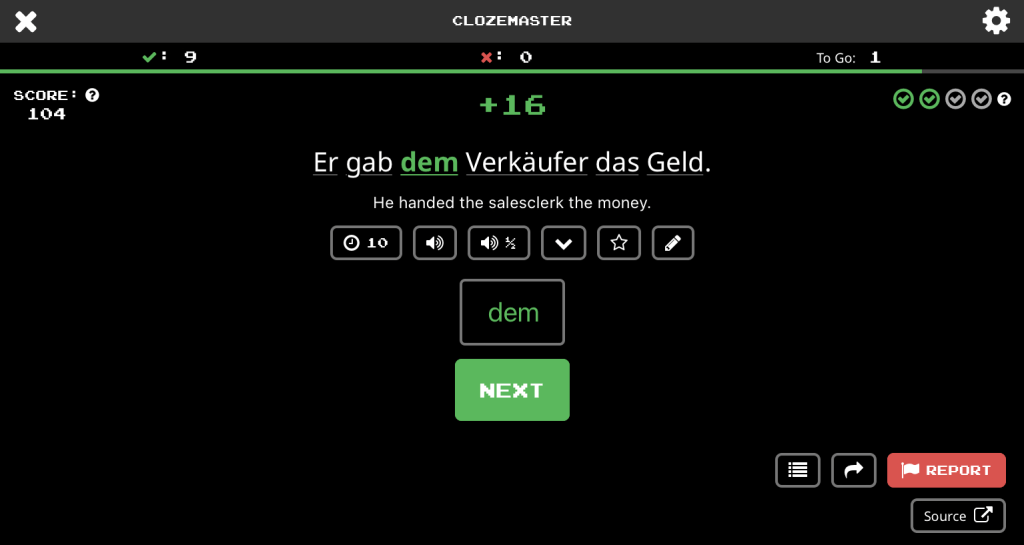
Words are generally organised into collections. While first-party collections might not really indicate which kinds of words you would expect to find per collection, words may be organised by grammar units, or by how common they are. These words and sentences were drawn from the tatoeba database, and open database containing sentences and corresponding translations. Frequency lists for Japanese, on the other hand, take reference from the Japanese Language Proficiency Test, giving kanji some precedence over other words.
To aid in review, Clozemaster uses a spaced repetition method similar to that used by Memrise. Words are divided into 0%, 25%, 50%, 75%, and 100% mastery, which resets to 0% when a sentence has an incorrect response regardless of mastery level. With each mastery level, the time interval between reviews will be increased, from 1 day at 25% mastery to 180 days at 100% mastery. For a free plan, this interval is rigid, and cannot be customised.
If you are on a free plan, you can practice up to 30 sentences a day. Depending on how much time you allocate per day to language learning, this might be just right, or too little. Over the weeks and months of usage, this could account for anywhere between 5 and 15 minutes of word usage practice per day, so your mileage may vary on a free plan.

Some glaring issues
Perhaps the one issue I could identify in this diversity is the strong bias towards pushing languages spoken in Europe, since a majority of these languages covered are European ones. Perhaps the few indigenous languages I could find spoken in the Americas are Guarani and Nahuatl, and the few African languages available are Swahili, Amharic, and Afrikaans. In fact, there were more constructed languages available in Clozemaster than the natural languages from those continents respectively. Namely, the constructed languages available are Lojban, Interlingue, Esperanto, and Toki Pona.
Another Issue, albeit a more minor one, is the use of country flags to represent the areas most associated with the language covered. For some reason, Traditional Chinese is represented by the flag of the People’s Republic of China, despite not being used in China today. Portuguese is represented by the Brazilian flag, which could suggest Brazilian Portuguese is covered here instead of Portuguese Portuguese. Lastly, the Egyptian flag is used to represent Arabic, which is an entire can of worms to deal with as Arabic has numerous regional varieties, such as Gulf Arabic, Levantine Arabic, and Egyptian Arabic. Each variant has its own unique flair of vocabulary that will sound foreign to speakers of other varieties of Arabic, and learners of Modern Standard Arabic (MSA). If it is indeed used to represent MSA instead of Egyptian Arabic, then that would be another misrepresentation to note.
My impression is, the app probably identifies the countries or regions where the language is most commonly spoken, and assigns that corresponding flag to that language, although that might not be true of Spanish (as Mexico has the most number of Spanish native speakers), and arguably, French (as the DR Congo is purported to have more French native speakers than all of France).
The other shortfall I want to cover is the choice of word options used when multiple choice mode is chosen. Usually, cloze options would be related to the missing vocabulary in the sentence in question, and could have very close meanings to one another. This provides a challenge to the user in selecting the word with the most appropriate usage for that context.
However, Clozemaster does not seem to apply this consistently in its multiple choice exercises. Sometimes, at least one of the options do not make any sense — these could be grammar particles, pronouns, or unrelated to the missing word in question. While Clozemaster is transparent on the method on selection of blanks, it is not so transparent when it comes to choosing words to be used as options for these exercises.
Here are a couple of examples, using German as the target language. In the first one, the available options are Wollten (wanted), Gefällt (likes), Ewigkeiten (ages, eternities), and Dich (you). In this sentence, you could immediately eliminate all other options and select Ewigkeiten as the correct option, as the others do not really make any sense. A better selection of options would have been related words or synonyms of Ewigkeiten, like Langwierig, or Aeonen. This could have provided further information on not only why Ewigkeiten was the most appropriate one, but also why the other options, though related to it, are not.

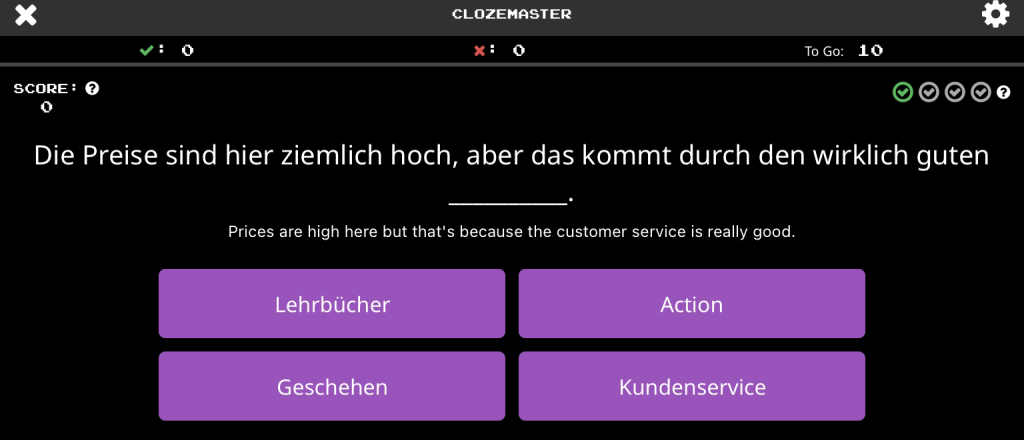
In the second one, the available options are Lehrbücher (textbooks), Action (action), Geschehen (done, occurred, happened), and Kundenservice (customer service). Once again, the words used as options could have been more or less related to Kundenservice, the correct option here. As such, this gave an impression of matching word to sentence, rather than understanding the nuances between very similar words, and their corresponding contexts in which they are used. The improvement in selection of cloze options would make Clozemaster more effective in training vocabulary through this method, and would make a welcome change.
Accommodating non-Latin writing systems
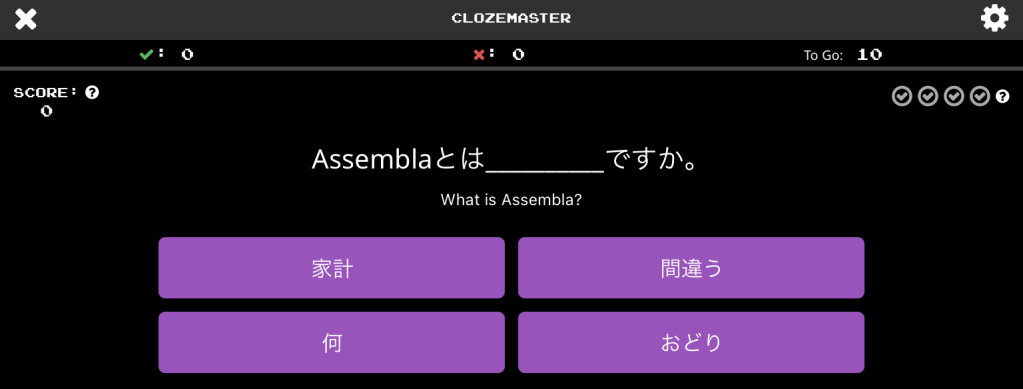
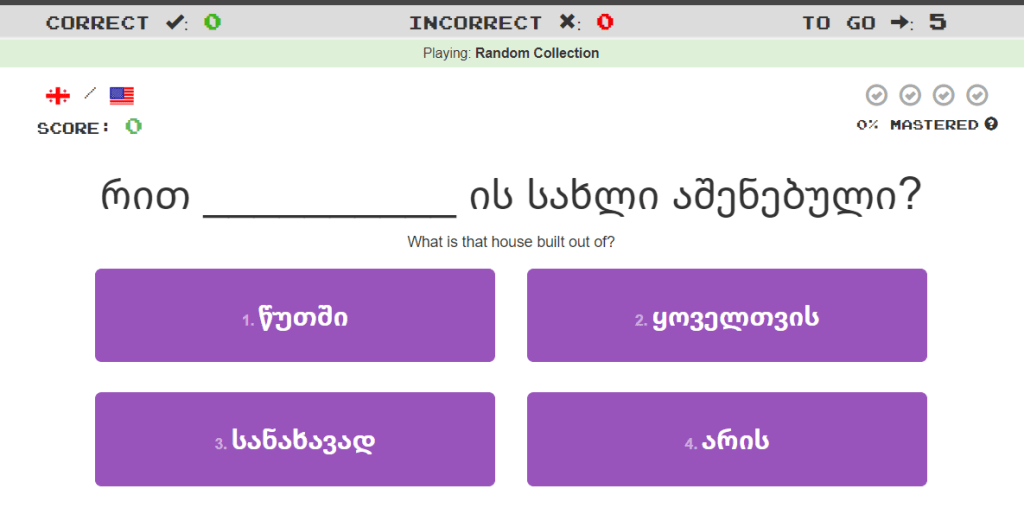
If you are learning a language which uses a different writing system, you are expected to be more or less familiar with that writing system before attempting the exercises. I do not recall there being an option for a romanised version or transcription to aid familiarisation with the writing system, although that could be an improvement. However, a voiceover does play after the round, giving an idea on how it is pronounced. This applies for both the vocabulary and listening formats.
Final thoughts
Overall, I really enjoy learning languages using Clozemaster, as it tries to teach the usage of some vocabulary, as well as some grammatical forms. This gives it an edge above apps like Memrise and Drops, as it contextualises words that you learn. But of course, it comes with its own downsides when it comes to the limited exercises you can do per day on a free account, the expectation that you are more or less familiar with the writing system your target language is using, and the rare case where a question just sounds unnatural or ungrammatical. If you want to ‘graduate’ from the Duolingo and Memrise training wheels and move on to something else, Clozemaster would be among my recommendations. To sum up my thoughts and evaluation of Clozemaster, I have prepared a table below:
| The good | The not-so-good |
| Many available selections for target languages | Many of these selections focus on European languages, or Indo-European languages |
| Very customisable experience, even on the free plan | Cloze options may not make sense |
| Positions itself as a great alternative to larger applications like Duolingo, and satisfies that role | Only 30 sentences may be practiced per day on a free plan, equating to anywhere from 5 to 15 minutes of usage |
| Supports multiple choice, freeform response, listening, and speaking options |
The Language Closet Rating: 7.5/10
Note: This rating is based on user experience, criticism and evaluation through this post. It is in no way an objective stance, nor is it a static rating. This can change if Clozemaster undergoes marked improvements or changes, which will warrant another review here in due time.
How would you rate Clozemaster? How has Clozemaster shaped your learning experiences? Let us know through the comments!
 The Language Closet