For the past month or so, we have been on quite a streak with content surrounding Mandarin Chinese, but there are so many relatively obscure things about writing Chinese that many speakers, both native and non-native, often overlook. Today, we introduce the system of simplified Chinese characters that have dodged most people in the years it existed.
Turn your calendars back to 1969. Richard Nixon is sworn in as the 37th President of the United States. The Boeing 747 is flown for the first time. The Mariner 6 probe launches. The first Concorde test flight is conducted. And perhaps the most notable event that year, the first Moon landings take place, as hundreds of millions watched the first humans to ever step foot on the Moon.
But in the island nation of Singapore, a reform was underway, harkening back to the 1956 scheme to simplify Chinese characters in the People’s Republic of China. Something that would impact education, standardisation, and printing of Chinese characters in educational materials, publications, and even identity cards of the Chinese Singaporean population.
This started with the 502 list, released by the Ministry of Education in 1969. 502 traditional characters were slated for simplification, leaving us with 498 simplified characters for the first phase of the simplification process. This was then trialed from 1969-1974, from which it was reported that it was “well-received” by the Mandarin Chinese-speaking Singaporeans.
And so, in 1974, the Ministry of Education dropped yet another set of characters, this time consisting of 2287 simplified characters, called the 《 简体字总表》, or Master List of Simplified Characters. But looking through this list, while there was a sizable majority of characters which were consistent with the simplified characters in China, there were some, well, anomalies. Additionally, Chinese textbooks were to be printed horizontally instead of vertically, a change that trailed China’s introduction in 1955. Newspapers soon followed suit, although it might have taken some years for that change to take effect as we can see from the newspaper article from 1975 below:
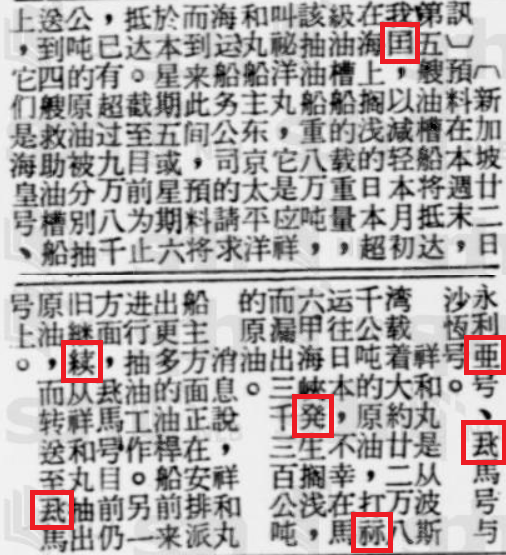
There are generally four patterns these simplified characters with differences from China’s simplified characters fall into, and we will start with characters sharing similarities, or are identical to their counterparts in the second round of simplified Chinese characters, which we have covered previously. This includes characters like:
| Traditional | 信 | 貌 | 嘴 | 留 | 答 | 算 | 解 | 賽 | 剎 | 褲 |
| Singapore Simplified | 伩 | 皃 | 咀 | 畄 | 荅 | 祘 | 觧 | 𡧳 | 杀 | 衭 |
For the patterns used in getting simplified characters like this, please refer to our post on the time China tried to simplify Chinese characters, again.
Some Singapore simplified characters look strangely like Japanese kanji. While it looks like a case of convergence, there is also a simplification pattern that was applied where the radical is not simplified, but the other components of the character are. This simplification just coincidentally yielded characters starkly similar to the kanji counterparts. Some examples include:
| Traditional | 亞 | 繪 | 覺 | 發 | 繼 | 證 | 鐵 | 肅 | 惡 | 廢 |
| China Simplified | 亚 | 绘 | 觉 | 发 | 继 | 证 | 铁 | 肃 | 恶 | 废 |
| Singapore Simplified | 亜 | 絵 | 覚 | 発 | 継 | 証 | 鉄 | 粛 | 悪 | 廃 |
That being said, some characters that retained the traditional form of radicals, but simplified the rest of it did not appear anything like kanji. It does present itself like some sort of “evolutionary intermediate” between the traditional and currently-used simplified counterparts, some examples of which are shown below:
| Traditional | 綱 | 繩 | 識 | 質 | 鐘 | 饑 | 鷄 | 觀 | 織 | 藥 |
| China Simplified | 纲 | 绳 | 识 | 质 | 钟 | 饥 | 鸡 | 观 | 织 | 药 |
| Singapore Simplified | 䋄 | 䋲 | 䛊 | 貭 | 鈡 | 飢 | 鳮 | 覌 | 𥿗 | 葯 |
Lastly, we have the characters that differ from China’s simplified characters, but do not fall into any of the above categories. There does not seem to be any identifiable pattern of simplification here, other than the use of another component used to simplify, or to retain a radical and simplify it, and things like this. Some characters were simplified and do appear relatively graphically ‘balanced’ compared to China’s counterparts, while others look more jarring.

This system of simplification would be short-lived. In 1976, Singapore officially conformed with the simplification of Chinese characters as used by the People’s Republic of China, with the removal of some simplified characters that were unique to Singapore’s simplified characters. This marked a quiet end to a transition from the use of traditional Chinese characters to simplified Chinese characters in Singapore. Naturally, this transition period slipped from the memories of many, as simplified Chinese characters become ever more ingrained in Singapore over the decades. Unlike some characters affected by the second round of simplified characters in China, the Singapore simplified characters simply just ceased to exist.
But the legacy of these simplified characters was somewhat significant. This 7-year-long period of transition from traditional to simplified Chinese in Singapore showed a period of confusion in the usage and standardisation of written Chinese, and how these would be implemented in the education system. If one grew up and spent a significant portion of their primary and secondary education during 1968-1976, they would have had gone through Chinese education using traditional Chinese characters, Singapore simplified characters, and simplified Chinese characters. In the years that followed, a so-called “wait and see” approach seemed to be taken, as China retracted the Second Scheme in 1986, and that the Chinese characters were stabilised and standardised in China. This then allowed the Singaporean Ministry of Education to make, if necessary, corresponding revisions to curricula and orthography.
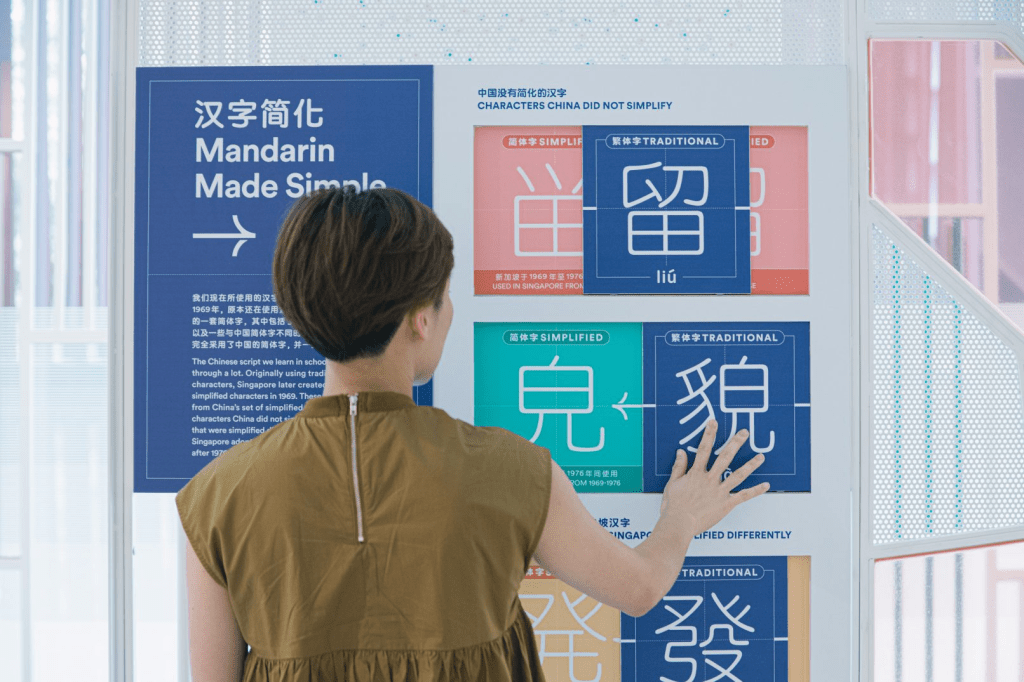
Evidence of its existence can still be found in newspapers of that period of 1970-1976, when the Mandarin Chinese newspaper Nanyang Business Daily printed articles in Singapore Chinese characters, although headlines were still largely printed in traditional Chinese. Accessing some of these articles can be done online through the NewspaperSG website, offered through the National Library Board. In addition to reading through some historical events, you might just encounter more examples of Singapore Chinese characters, long relegated to the early-to-mid 70s.
 The Language Closet
Wow!! I’ve been curious about this set of characters for a very long time… Not much can be found on the internet. Tried my luck again today, after a couple years, and wow!! Your article even goes as far as to show printed material with these characters. A dream come true…
LikeLike