Over the years of learning languages, and scrolling past language meme pages, I have come across certain posts regarding what sounded like ridiculous pidgins like Basque-Icelandic pidgin. There are perhaps at least a couple reasons behind this, like how Basque is a language isolate, and how it interacts with languages almost nobody thinks of right away, like Icelandic. So today, I thought we would cover two of the Basque pidgins that have risen to the spotlight because of just how weird it sounds to the layperson.
Basque-Icelandic Pidgin
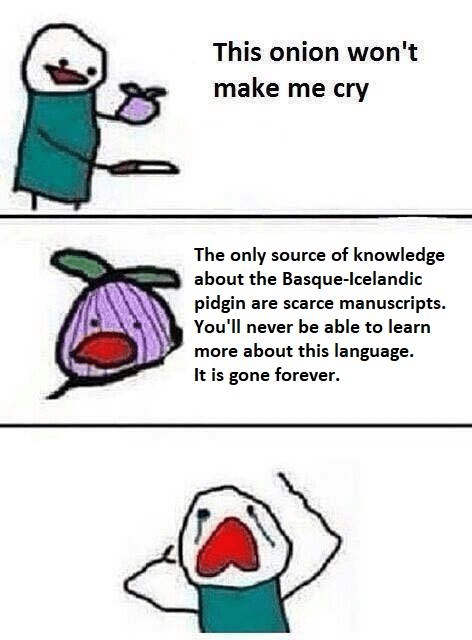
There were a lot of Basque-Icelandic Pidgin memes around social media at some point, and for particularly good reason. Basque, being a language isolate interacting with something so distantly spoken (geographically speaking) as Icelandic in the past sounded like an extremely unlikely scenario. Yet the two languages did interact, way back in the 17th century. In fact, Basque-Icelandic Pidgin was a Basque-based pidgin, with influences from Germanic and Romance origins, so it is not necessarily a mixture between Basque and Icelandic, but more rather, a mixture between Basque and languages like Dutch, French, Spanish, and even English.
But how did this come about? Well, the Basque people were among the first people groups to do commercial whaling, dominating this trade for several centuries, and spread throughout the North and some parts of the South Atlantic. Their first voyages to Iceland dated back to around 1600, likely in the Westfjords as that is where most of manuscripts were written. With no common language between the Basque people and the Icelandic people, some form of pidgin thus developed to ease communication between the two people groups.
While French and Spanish whalers started to appear more often in Icelandic records later in the 17th century, with the presence of Dutch, English, and German words in the pidgin, it is hypothesised that these whalers could have had this pidgin already, before sailing to trade with the Icelandic people. However, where this pidgin could have otherwise arisen is not really known for sure. For French and Spanish, it could also have been the case where French and Spanish influences have entered Basque throughout its history, and that French and Spanish loanwords in Basque were then incorporated into the pidgin. Sailors could also have been multilingual as well, contributing to some variation in the words recorded in manuscripts. Notably, is the word for “yes”, being translated as Icelandic ja, Basque bai, and French vÿ in the Vocabula Biscaica.
The glossaries recovered contained hundreds of words, phrases, short sentences, and numerals. Most notably was the Vocabula Biscaica, where some obscenities and profanities were covered as well like fenicha for ju and Liggia þig (f*** you), and the more figurative Christ Maria presenta for mi Balia, for mi, presenta for ju bustana for Basque, and Gefe Christur og Maria mier hval, skal jeg gefa þier spordenn for Icelandic (If Christ and Mary give me a whale, I will give you the tail). You may have noticed that the pronouns “for mi” and “for ju” do sound oddly like “for me” and “for you” respectively, and they do come from Germanic origin, particularly English or Low German. So yes, it turns out Basque sailors did have their own colourful language like other sailors of the era.
Algonquian-Basque Pidgin
Now, for a more peculiar pidgin combination. If most people have yet to hear of the Basque language, then they would be rather likely to have never heard of the Algonquian part. Known as the Souriquois, the Algonquian-Basque pidgin emerged some time in the 16th century, and was last attested in the early 18th century. So, who were the Algonquian peoples?
The Algonquian peoples are among the most widespread indigenous people groups in North America, with pre-European-contact distribution spanning from the Atlantic Coast, to the Great Lakes and Saint Lawrence River, in what is today Canada and the US. Together, they speak the Algonquian languages, a branch of American indigenous languages encompassing dozens of languages, like Ojibwe, Cree, Massachusett, and Mi’k’maq.
Contact between the Basque and Algonquians most likely arose through, once again, the whaling, fishing, and trading communities. When the Basque first settled on North America, in what is now Newfoundland and Labrador, they encountered the indigenous populations there, with whom they had relatively good, and relatively hostile relations. Particularly, the Basque had relatively good relations with the Montagnais and St Lawrence Iroquoians, but considered the Inuit hostile. As such, the Algonquian-Basque pidgin primarily consisted of words from Basque, Mi’k’maq, Innu, and interestingly, Gascon, a language spoken in southwest France in the 16th century. During that period, the French also sent expeditions to America, and followed the Basque routes and reached the Gulf of St Lawrence, from which they started their conquest of North America. Buber’s Basque Page goes deeper into the history of this pidgin, so I would recommend checking their site out!
So, what was the consequence of this linguistic encounter? Basque words actually found their way into the Mi’k’maq language, like atorra (“shirt” in Basque) entering the lexicon as atlei. However, it is not known why the pidgin fell out of use. A likely hypothesis was the growing French and English influence across North America as they sought to colonise the lands. Another would be the limited use of the pidgin outside of the trading, fishing, and whaling industries.
Of course, there could be many more other Basque-based pidgins that have existed, as the whaling and fishing practices of the Basque people did spread across the Atlantic, from Iceland to as far as Brazil. However, as we have seen from these two examples, documentation and evidence for the pidgin as manuscripts are hard to come by, and so whichever other pidgin that may have been spoken before by the Basque could have been long gone to history. Yet, these two notable pidgins still continue to capture the attention and marvel of many, as shown in these language memes.
 The Language Closet